
Japan seeks Thai partnerships in food export expansion drive
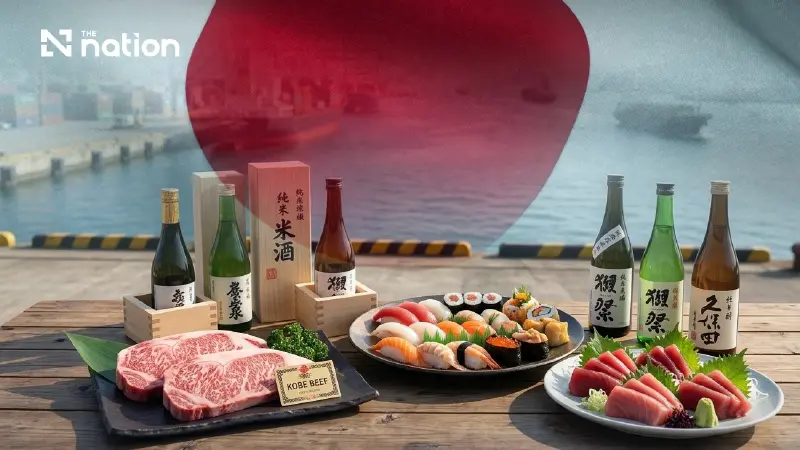


Japan seeks Thai partnerships under a plan to support 10,000 food exporters, with food innovation and higher-value products central to cooperation.
- Japan is seeking partnerships with Thai importers, distributors, and restaurants as part of a national program to support 10,000 of its food exporters.
- Thailand is a key target market, ranking as Japan's seventh-largest destination for agricultural and food exports, with the value of these exports growing by 11.4% in the first half of 2026.
- This partnership initiative is part of Japan's larger government goal to increase its total food-related exports to 5 trillion yen by 2030.
- The program aims to strengthen commercial links by generating overseas demand, increasing the number of Japanese exporters, and developing higher-value processed products for international markets.
Japan is seeking closer partnerships with Thai importers, distributors and restaurants through a programme aimed at supporting 10,000 food exporters, with rising export values underlining Thailand’s importance as an overseas market.
Programme documents identify cooperation with Thai businesses and consumers as a way to create additional value for Japanese food products and strengthen commercial links through food innovation.
The initiative could provide opportunities for Thai trade partners as Japan works to broaden its exporter base, develop higher-value processed products and reach more international markets.
Thailand retains seventh place as export values rise
Japanese exports of agricultural, forestry, fishery and food products to Thailand reached 40.9 billion yen in January–June 2026, an increase of 11.4% from 36.7 billion yen during the same period a year earlier.
Thailand remained Japan’s seventh-largest export destination for these products, according to figures from the Ministry of Agriculture, Forestry and Fisheries (MAFF), based on Ministry of Finance trade statistics.
The growth followed exports worth 73.5 billion yen to Thailand in 2025, up 17.1% from the previous year, when Thailand also ranked seventh.

Major products exported to Thailand include sardines, scallops, bonito and tuna, beef, mackerel and green tea. The range spans seafood, meat and higher-value food products.
Japan targets exports of 5 trillion yen by 2030
The Thai partnership plans form part of “The Program to Support 10,000 Food Exporters from Japan”, jointly launched on April 10 by the Ministry of Economy, Trade and Industry (METI) and MAFF.
The programme aims to help more Japanese businesses enter overseas markets and accelerate growth in agricultural, forestry, fishery and food exports.
Japan’s exports in these categories totalled 1.7 trillion yen in 2025, an increase of 12.8% from the previous year, according to Ministry of Finance trade statistics.
The government aims to raise the value to 5 trillion yen by 2030 while diversifying export destinations beyond a small number of major markets.
Overseas demand, new exporters and higher-value products
The programme has three main priorities: generating overseas demand, increasing the number of businesses capable of exporting, and developing higher-value products suited to international consumers.

To strengthen overseas demand, Japan plans to expand the offices and personnel of the Japan External Trade Organization (JETRO), helping build networks with local buyers.
Support will also extend to overseas demonstrations of food-related technologies, including plant factories and cold-chain systems. Social media influencers will be used to promote Japanese food, particularly products made from rice flour.
METI and MAFF will draw on their office networks and support measures to help more businesses enter international markets. Further assistance will involve online shopping platforms and efforts to encourage foreign visitors to Japan to purchase Japanese products, creating additional export opportunities.
The product-development measures will place greater emphasis on processed goods rather than relying solely on agricultural and seafood products sold as raw materials.
Food manufacturers and seafood processors will receive support to develop products with greater added value that meet the needs of overseas consumers.
Japanese firms expand through technology and e-commerce
Businesses benefiting from Japanese support measures include Maneki Foods in Hyogo Prefecture, which has adopted freshness-preservation technology to extend the shelf life of frozen boxed meals.
The company has also installed specialised freezing equipment to increase production capacity ahead of expansion into European and Asian markets.
Hokuriku Seika in Ishikawa Prefecture has used JETRO’s e-commerce support services to promote its confectionery products. It currently exports to Asian markets and is working to expand into Europe and the Middle East.
These business-support measures sit alongside Japan’s wider efforts to develop processed products and strengthen commercial networks in target markets, with Thailand remaining an important destination for its export expansion.
