
Police seize 90 cannabis jellies in Bangkok tourist district
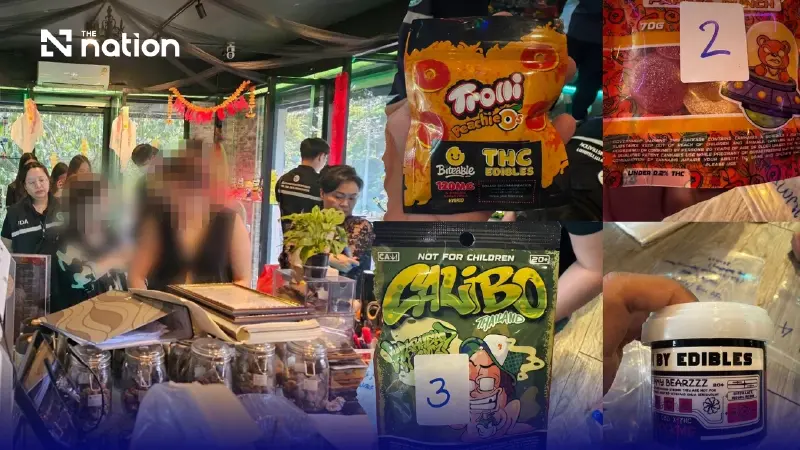


Thai police seized 90 cannabis jellies in Bangkok’s Banthat Thong area after reports of a family falling ill prompted an inquiry. Laboratory tests are pending.
- Police and health officials seized 90 cannabis-infused jellies from a shop in Bangkok’s Banthat Thong tourist district.
- The raid was prompted by an investigation after a family, including a two-year-old child, was hospitalized after consuming cannabis sweets.
- The seized products, valued at THB50,000, were illegal as they lacked the required Thai-language labels and food registration numbers.
- Authorities are investigating the shop for suspected offences including selling a controlled herb without a licence and improper food labelling.
Police and health officials have seized 90 cannabis-infused jellies without Thai-language labels or food registration numbers from a shop in Bangkok’s Banthat Thong area, following an investigation prompted by reports of a family falling ill after consuming cannabis sweets.
The Central Investigation Bureau (CIB), Food and Drug Administration (FDA) and Department of Thai Traditional and Alternative Medicine conducted the raid on October 29, 2026. Details were released on November 1.
Investigators are examining suspected controlled-herb licensing and food-labelling offences. Samples will undergo laboratory testing to determine whether further charges are warranted.
Search warrant leads officers to cannabis shop
Officers executing a search warrant issued by the Pathum Wan District Court entered a building in Wang Mai subdistrict, Pathum Wan district. Its second floor was being used as a shop selling cannabis and cannabis flowers.
The search team was led by Pol Lt Col Surasee Khongthap, an inspector with Sub-Division 4 of the Consumer Protection Police Division, alongside FDA and traditional medicine department officials.
Authorities seized 90 cannabis-infused jelly products, which they valued at THB50,000, and handed them to investigators.
Saowalak, 26, whose surname was withheld, showed officers around the premises. According to police, she identified herself as an employee responsible for selling the jellies at THB80 each to members of the public and foreign tourists.
She told investigators the business had been operating for about a year.
Family’s hospitalisation prompted investigation
Police began investigating after social media reports emerged about a father, mother and their two-year-old son in Khlung district, Chanthaburi, who became ill after eating sweets containing cannabis.

According to the reports cited in the release, the adults experienced severe symptoms, including muscle stiffness, convulsions and unconsciousness, requiring ventilator support.
Their son was lethargic and was thought to have consumed a smaller amount. All three were taken to hospital for urgent treatment.
The FDA subsequently coordinated with consumer protection police, whose investigation identified a seller of cannabis jellies in Banthat Thong.

Investigators reported that the products were advertised on social media and packaged to resemble ordinary jelly sweets sold for children.
The release did not establish that the sweets consumed by the family came from the raided shop.
Laboratory findings could lead to further charges
Investigators will submit samples to the Department of Medical Sciences under the Ministry of Public Health to test for tetrahydrocannabinol (THC) and cannabidiol (CBD).
Additional charges may follow if testing finds concentrations exceeding the prescribed limits.

Authorities initially identified suspected offences under the Protection and Promotion of Traditional Thai Medicine Wisdom Act B.E. 2542 (1999) and the Food Act B.E. 2522 (1979).
Selling a controlled herb without a licence carries a maximum penalty of one year’s imprisonment, a fine of THB20,000, or both.
Producing and selling food with incorrect labelling carries a maximum fine of THB30,000.
FDA warns parents about cannabis sweets
FDA secretary-general Supattra Boonserm warned that children should not consume food containing cannabis. Adults choosing such products should buy only those authorised by the FDA following a safety assessment.
She cited a THC limit of 1.6 milligrams per bottle, box or sachet for authorised products, alongside requirements for consumption instructions and prominent safety warnings.
Required label advice includes: “Do not consume more than two packages — bottles, boxes or sachets — per day.”
Labels must also state: “Children, pregnant women and breastfeeding women should not consume this product”; “Stop consumption immediately if unusual symptoms occur”; and “People allergic or sensitive to THC or CBD should exercise caution.”

Supattra cautioned parents against allowing children to eat illegally manufactured or imported cannabis jellies without food registration numbers.
She advised consumers to watch for products lacking Thai-language labels and packaging bearing cannabis-leaf images or wording such as “Cannabis”, “CA” or “THC”.
The FDA and provincial public health offices will monitor products across the country and take legal action where violations are found.
Tourist-area shops face compliance checks
Dr Pongsadhorn Pokpermdee, director-general of the Department of Thai Traditional and Alternative Medicine, explained that the Ministry of Public Health had instructed his department to monitor cannabis shops’ compliance with controlled-herb legislation, particularly in busy tourist areas.
The priorities include preventing misuse, keeping cannabis away from children and young people, and ensuring products and services meet legal standards.
Pongsadhorn called on operators to comply with the law to protect residents and visitors and maintain confidence in Thailand’s tourist destinations.
CIB commissioner Pol Lt Gen Natthasak Chaowanasai warned that cannabis was being added to jellies, cookies and other foods for intoxicating rather than medical purposes.
Attractive colours and sweet-like appearances could lead children, young people and other consumers to eat the products unintentionally, he cautioned.
Natthasak also expressed concern about cannabis sweets reaching communities and areas around schools. Police would continue enforcement operations and pursue legal proceedings against offenders.
Joint operation and public reporting
The operation involved CIB deputy commissioners Pol Maj Gen Sophon Saraphat and Pol Maj Gen Sarut Khaengsopha, together with Consumer Protection Police Division commander Pol Maj Gen Kritsadaporn Panprong.
The division’s deputy commanders, Pol Col Anuwat Rakcharoen, Pol Col Chat Nakkaew, Pol Col Samroeng Amphanthong and Pol Col Phatthanaphong Sriphinphro, were also named in the operation, along with Sub-Division 4 superintendent Pol Col Weeraphong Klaithong.
FDA officials included deputy secretary-general Dr Pichet Phuetkhunthot and pharmacist Morakot Charunwatthana, an expert in the safety and efficacy of public health products and their use.
Consumers can report suspected violations or raise product-safety concerns through the FDA hotline on 1556, email [email protected], or provincial public health offices. Postal complaints can be sent to P.O. Box 1556, Ministry of Public Health Post Office, Nonthaburi 11004.
Police also accept reports through the Consumer Protection Police Division hotline on 1135 and its consumer-alert Facebook page, “ปคบ.เตือนภัยผู้บริโภค”.
The release stressed that suspects and defendants are presumed innocent unless a final court judgment establishes guilt, and asked the media to respect their rights.
