
Tablet PCs good for students provided 'access can be restricted'


Play
It has been proved that tablet PCs can make passive students into active learners, an education seminar was told on Wednesday.
The Innovation for Education Foundation (InnoFed) launched a study last year to study the benefits and problems of using iPads in classrooms, InnoFed committee member Wiroj Assawarungsi said. The study covers schools in Bangkok, Chon Buri and Khon Kaen.
The study was presented as part of Educa 2011 and the 4th Annual Congress for Teacher Professional Development held at the Bangkok International Trade and Exhibition Centre. The threeday forum wraps up today.
At the opening ceremony of the forum, Sumate Yamnoon, adviser to the education minister, said: “To reach global standards, we should not just learn from our own experiences but also look outside and learn from others. One solution cannot be applied to all countries, but at least there are some models that work effectively in some countries and can be adapted to work for our country as well.”
In the study, Wiroj said that good teaching methods were needed and teachers had to learn how to use different applications so they can encourage students’ learning and get them to pay more attention in class.
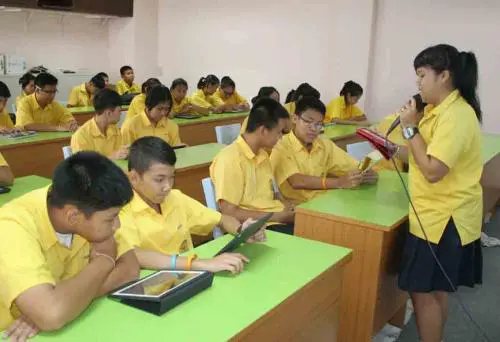
“We have found that students focus more on tablet PCs, and though it was difficult for teachers to control them in the first week because they were not used to the technology, things became much easier later,” he said, as he showed photographs of students using the iPad during class.
“Many students, including those who perform poorly or do not concentrate, showed a change in their behaviour. They seemed to find seeking answers and participating in education activities more enjoyable. By interacting with teachers, they have become active learners and some showed better academic performance,” he added.
Wiroj said that though he fully backed the government’s policy to hand out tablet PCs to students, he warned that teachers should first be trained properly otherwise youngsters would start misusing the devices. “If teachers are not prepared, don’t hand them out to students,” he advised.
He said the target group for this policy – Grade 1 students – were not too young to use these devices provided they participated in other activities as well and parents and teachers set rules for using their tablet PCs.
“In the US, children as young as twoandahalf years old use tablet PCs, which encourages them to go to school,” he said.
Wiroj added that children’s privacy, safety and security were crucial and the iPad had a contentrestriction function that could prevent the young from having access to improper or harmful content. Hence, the government should purchase tablets that have inbuilt restrictions. He also said that the government’s idea to buy cheap devices was not good because they will be of low quality, and the battery might explode. Also, the devices might not have the restriction function.
The study, which involves tablet PCs being provided to many provincial schools, will be concluded by the end of this month. Schools interested in participating can call (02) 440 0330.
