
An island sanctuary amid the deluge in Ayutthaya


Play
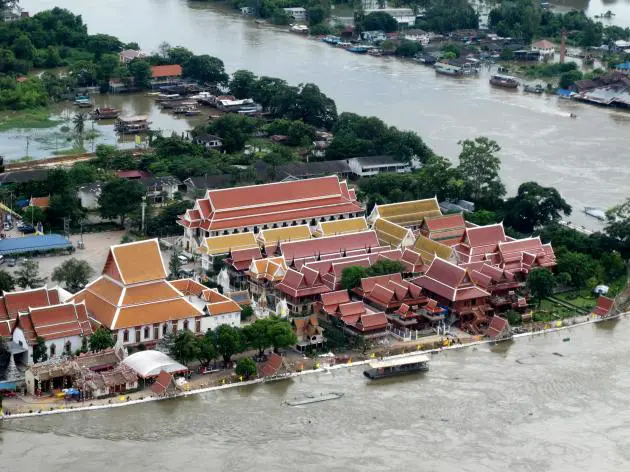
Unlike the many swamped historic sites and ancient temples in heavily flooded Ayutthaya province, Wat Phanan Choeng Worawiharn has stood majestically free of the inundation, thanks to the temple management's adequate preparations and awareness of dangers
“We have been following the situation from the beginning, checking the direction and volume of flood water since August,” said assistant abbot Phra Maha Cherdchai Katapunyo.
“As we are on the Chao Phraya riverbank, on the outside of a bend where Pa Sak and Chao Phraya meet, the currents hit the temple harder, and the barriers therefore need to be stronger,” he added.
During 1995’s heavy flooding, when the four-month inundation caused more than Bt20 million in property damage, the management at Wat Phanan Choeng learned a technique to make its sandbag barriers stronger – the bags are not filled to the top, and bags must not be tied, but only folded closed.
“Experienced monks and volunteers stack the bags tightly in layers, then cover them in canvas. The sandbag walls are reinforced by clay and by wooden stakes,” said Phra Maha Cherdchai.
Wat Phanan Choeng has spent Bt6 million on flood barriers and water drainage this year alone.
Abbot Phra Raj Rattana Waraphon, also the provincial monastic chief, said permanent concrete barriers would be built to fight off flooding, which he now expects to arrive every year. “Flood water used to flow southward through fields and plains, but these have now become factories and housing estates,” he explained.
Apart from conserving historic sites and artefacts within the dry compound, Wat Phanan Choeng has served as a large shelter for the neighbourhood’s residents as well as a logistics and supply base to feed and aid flooded communities and other temples nearby. “Monks and novices deliver relief supplies by rowing boats to those in need,” he added.
Montha Kittichai, a 68-year-old food vendor who endured the 1995 flooding, said nearby residents were willing to live outside the temple’s 5-metre flood barriers in waters of up to 1.5 metres deep for months.
“We are willing to sacrifice for Wat Phanan Choeng. Even at such a hard time, we still have Luang Phor To [the temple’s main Buddha image] as a centre for our unity and community morale,” she said.
Luang Phor To – or Phra Phuttha Trai Rattana Nayok, as it is officially known – was erected in 1324. The seated-Buddha image is 19 metres high with a lap that measures more than 14 metres wide. It was renovated in 1928 after being damaged by fire in 1901.
