
Chalerm -- the power behind the scenes
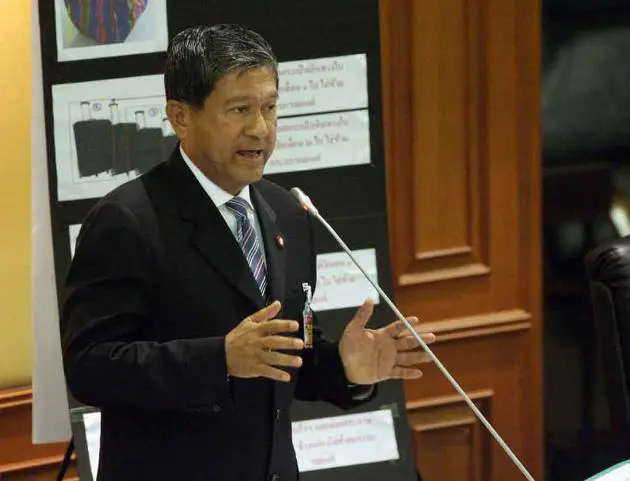


Since this government took power four months ago, Deputy Prime Minister Chalerm Yoobamrung seems to be emerging as the most outstanding member of the Cabinet.
Since August 23, when Prime Minister Yingluck Shinawatra declared her administration’s policies before Parliament, Chalerm has been acting as a trainer/adviser/political bodyguard for the novice politician, who spent barely two months under the spotlight before her Pheu Thai Party won the July election.
Chalerm, believed to have been chosen by Pheu Thai’s “big boss” – fugitive former premier Thaksin Shinawatra – to do the job, appears to be performing his duty satisfactorily.
The veteran politician has been defending Thaksin’s little sister in Parliament, responding to opposition queries on government affairs and countering political attacks from opposition old hands. As a result, Yingluck has rarely been involved in parliamentary debates, either as an MP or as chief of the administrative branch.
Apart from this, Chalerm has also has been active in administrative work. As deputy premier in charge of police affairs, he was credited with appointing Pol General Priewpan Damapong – Thaksin’s close friend and former brother-in-law – as National Police chief.
Also recently, Chalerm chaired a Cabinet meeting behind closed doors on November 15 to reportedly pave the way for Thaksin to get royal amnesty. Yingluck, who was suspiciously absent from that controversial meeting, later denied she had skipped it intentionally.
Despite opposition from several elements, Chalerm has, until recently, been very insistent about seeking amnesty for Thaksin, even though a new law on the matter might benefit other individuals and groups involved in the political conflict.
The prime minister appears to listen to Chalerm, and is often seen seeking his comments and views. Also, most of the time, she agrees to his suggestions.
This could be because she trusts Chalerm completely because he is a veteran politician and has legal knowledge. Having completed a doctorate in law, the deputy PM oversees a team of legal advisers from the Council of State – the government’s legal advisory agency – and the Office of the Attorney-General, and can answer any legal questions related to the government’s work.
Chalerm made several comments related to important legal issues at recent Cabinet meetings. During the flood crisis, he said the government should not declare too many public holidays or impose an emergency decree as suggested by the opposition. He argued that doing so would only cause panic. As for border talks with Cambodia, Chalerm said the General Border Committee talks could go ahead without having to seek approval from the Cabinet or Parliament. His argument was that bilateral ties had improved tremendously under this government and therefore talks would be smoother.
“Chalerm has something to say about almost every issue. At some Cabinet meetings, he speaks more than the prime minister,” a fellow Cabinet member said.
The source, who preferred to remain anonymous, said Chalerm’s remarks opposing fellow Cabinet members’ views often caused dissatisfaction. “Tourism and Sports Minister Chumpol Silapa-archa [from the Chart Thai Pattana Party] has become Chalerm’s sparring partner because of this,” the source said.
On Tuesday, when the prime minister called in sick due to food poisoning, Chalerm again took over the weekly Cabinet meeting – albeit not the entire session.
First Deputy PM Yongyuth Wichaidit was given the job of chairing the meeting by the premier. However, Chalerm, the third deputy premier, ended up taking over after Yongyuth had to answer the call of nature. Yongyuth defended Chalerm taking over by saying the veteran politician was qualified to lead Cabinet meetings, the source said.
“Even though second Deputy Prime Minister Kittiratt Na-Ranong was present, Yongyuth still gave the job to the third deputy,” the Cabinet member said.
Since he is aggressive and outspoken, Chalerm rarely gets challenged at Cabinet meetings. Quite often, his remarks sound like he is giving out orders. Once, he even told Yongyuth – the first deputy PM – what he should do in his capacity as interior minister.
“It is funny to see the third deputy PM issuing orders to the first deputy. But Chalerm appears to love telling others what to do and being listened to,” a bureaucrat, who has been attending Cabinet meeting for a long time, said.
It looks like Chalerm is playing a role that is even more important than that of the first deputy PM – it’s almost as if he’s the real prime minister behind the scenes.
