
Checkpoints put on alert for drunks, speeders


Play
The Road Safety Centre yesterday ordered checkpoints to look out strictly for drunk or speeding drivers returning to Bangkok from spending the year-end holidays at their home towns.
The first five of the seven dangerous days of New Year festivities have killed 282 people and injured 2,783 in 2,544 traffic accidents nationwide, the centre reported.
Buri Ram was still the deadliest province with 16 fatalities, while Chaiyaphum was the only accident-free province.
Compared with last year, deaths were up by one, while injuries were down by 308 and accidents down by 337, Silapachai Jarukasemrattana, deputy permanent secretary for the Transport Ministry, said yesterday.
Chiang Rai had the most accidents at 95 while Nakhon Sawan was tops in injuries at 100.
On Monday alone, the fifth dangerous day, 41 people were killed and 401 injured in 377 road accidents. That was six fewer deaths than last year, 34 injuries fewer and 31 accidents fewer.
Drunk driving was blamed for 32.9 per cent of accidents and speeding 20.7 per cent.
Most accidents involved motorcycles, at 83 per cent. Half of the victims were of working age.
Almost 70,000 officials manning 2,468 checkpoints had stopped 724,752 vehicles and arrested 95,822 offenders, with 30,326 failing to wear helmets and 27,764 failing to produce a driver’s licence, Silapachai |said.
Wibul Sanguanpong, director-general of the Disaster Prevention and Mitigation Department, said that since yesterday was the last holiday, highways would be heavily congested with people going back to work, especially to Bangkok. The centre instructed police operating checkpoints particularly on main trunk roads to stop drunk, speeding or sleepy drivers and facilitate the flow of traffic.
In Nakhon Ratchasima’s Chok Chai district, a pickup truck crashed into a tree on Chok Chai-Dechudom Road at 1.50am, injuring six people. One of them was pronounced dead on arrival at a hospital.
Mittrapap Highway in the province, the gateway to the Northeast, started to fill up with vehicles, so traffic was only moving at 60-90 kilometres per hour. Up to 20,000 passengers were expected at Nakhon Ratchasima Bus Terminal, which laid on 500 Bangkok-bound buses with 50 spare coaches prepared to carry them.
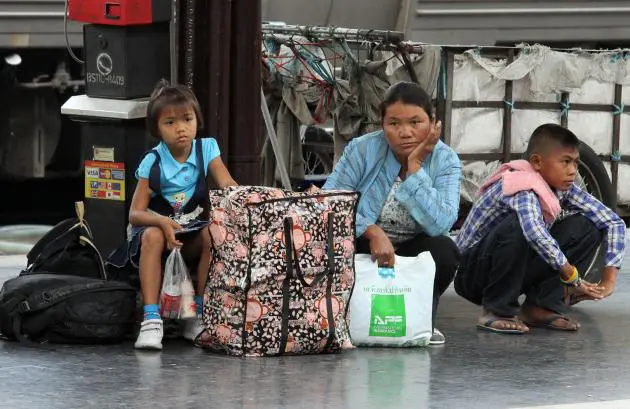
Hua Lamphong Train Station in Bangkok was crowded with returnees.
The State Railway of Thailand had scheduled 270 trips to serve some 120,000 expected travellers and was confident no one was left behind.
The southern floods cut short southbound train routes, which had to end at Nakhon Si Thammarat’s Khok Khram Station, Songkhla’s Hat Yai Station or Nakhon Si Thammarat’s Thung Song |Station.
