
Villagers want court to halt flood barriers
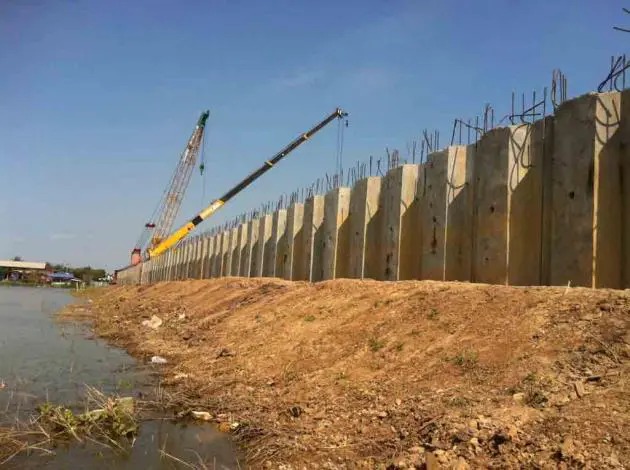


Residents near Ayutthaya estates say dykes will raise water levels
The Stop Global Warming Association and residents of Ayutthaya plan to ask the Central Administrative Court to issue an injunction suspending construction of antiflood dykes being built by seven industrial parks in the province, saying the barriers will cause damage to nearby homes in the event of future floods.
Association president Srisuwan Janya said about 50 local people living around industrial parks in Ayutthaya had authorised his group to represent them in filing a lawsuit with the Central Administrative Court against the Industrial Estate Authority of Thailand (IEAT) and four other state agencies.
Fears of property damage
“They are very worried that the construction of dykes around seven industrial estates in Ayutthaya province will cause damage to their houses and properties,” he said.
Some of the industrial parks in Ayutthaya province, including Nava Nakorn Industrial Estate and Rojana Industrial Park are installing concrete barriers to keep out flood waters. The dykes range in height from 5.5 metres to 6.5 metres. The construction is expected to be complete in three months.
Last year, Srisuwan represented 350 people who claimed the construction of “big bag” floodwalls exposed them to prolonged flooding. They filed a complaint with the Central Administrative Court against 11 agencies and officials on grounds of negligence, delayed delivery of services and committing actions that caused damages.
He said that in the event of another flood, the industrial estates’ protective dykes would elevate the water levels in surrounding areas, causing residents’ houses to be inundated.
Anond Snidvongs na Ayutthaya, a member of the government’s Strategic Committee for Water Resources Management (SCWRM), said the erection of flood barriers around industrial parks in Ayutthaya would block the passage of flood water and elevate the water above normal flood levels.
“The dykes will elevate the water level and affect residents’ houses surrounding industrial parks,” he said.
Suwat Wangwongwattana, secretarygeneral of the Office of Natural Resources and Environmental Policy and Planning, said he had asked the IEAT to submit details of an environmental impact assessment on the dyke construction, as well as measures to reduce the environmental impact, to an expert panel. The panel would give additional recommendations before the industrial parks continued with construction, Suwat said.
“So far, I have yet to receive an environmental impact assessment on these projects,” he said, adding that his agency had no authority to stop them. The IEAT and the Industry Ministry must take responsibility for and control of these projects to make sure they do not cause any damage, he said.
The five state agencies targeted in the lawsuit to be filed by Srisuwan are the IEAT, the SCWRM, the Finance Ministry, the Industry Ministry and the Government Savings Bank. Srisuwan said the agencies gave the green light and support to the industrial parks to install concrete and other types of flood barriers.
Srisuwan said the organisations violated Articles 57, 58, 66 and 67 of the Constitution, which require state agencies to consult the public on government projects that involve building in the community, especially projects or activities that could cause damage to the environment or people’s health.
‘Great wall of china’
“This is not a dyke against floods. This is a Great Wall of China,” Srisuwan said.
He said he had sent letters of complaint to several agencies, including the IEAT and the Industry Ministry’s Industrial Works Department, calling on them to seek opinions from local people living around industrial parks before going ahead with their plans to build dykes.
He said he informed the agencies that the dykes could be classified as harmful projects on which environmental and health impact assessments would need to be conducted according to Article 67(2) of the Constitution.
“I’ve just received a letter from the Industry Ministry’s permanent secretary, which said the construction of concrete walls and antiflood dykes was in compliance with the law and would not have any adverse impacts on local communities,” he said.
Ayutthaya resident Sawat Chomkrut, 51, who lives near the Nava Nakorn Industrial Estate, said no officials from the industrial park visited her home or sought her opinion on the impact of dyke construction in the area.
“I am afraid that my house will be under water again,” she said.
Last year, her twostorey house was partially submerged under 2 metres of water for over two months.
If the industrial park proceeds with the dyke, she said she wants the estate to at least leave its main entrances open, so that villagers living nearby can use them to access other nearby villages.
Another Ayutthaya resident, 70yearold Samruam Koksoongnern, who lives near Rojana Industrial Park, said he supported the estate’s plan to build a dyke to prevent a repeat of last year’s devastating flood damage.
The barrier would save many factories, which create jobs for local people, he said.
“The situation will get worse and worse if investors withdraw and move to another place,” he said. “That would mean there would be no work for us.”
