
Tablet bid 'winner' offers $81 per unit


Play
Cabinet expected to name Shenzhen Scope over three other Chinese firms
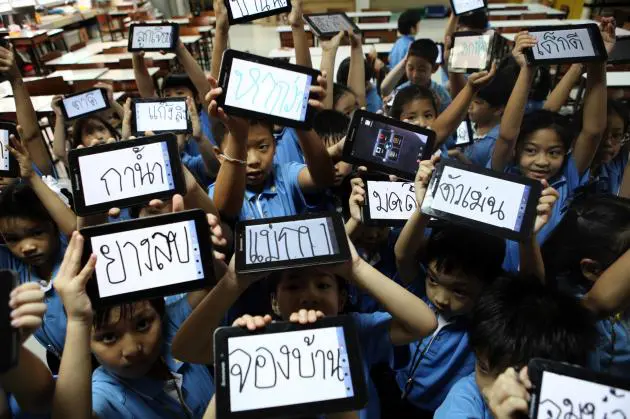
The Cabinet is expected to name the Chinese supplier for the One Tablet Per Child (OTPC) project today, with Shenzhen Scope Scientific Development Co tipped to win the order of up to 900,000 devices after it quoted the lowest price.
“It has offered to sell us tablets at just US$81 per unit, or about Bt2,400, excluding transportation costs,” Information and Communications Technology Minister Anudith Nakornthap said yesterday after a meeting of the OTPC committee.
The three other bidders – TCL Corporation, Haier Information Technology (Shenzhen) Co and Huawei Technology Co – asked for $89, $103 and $135 per tablet computer.
The Foreign Ministry negotiated with China for the procurement. Based on the terms of reference, the Chinese government recommended the four vendors, Anudith said.
“Our team then flew to China to check their facilities,” he said.
The OTPC committee marked Shenzhen Scope as the No 1 choice, followed by TCL, Haier and Huawei, he said.
Anudith said he plans to ask the Cabinet to approve the purchase of tablets from Shenzhen Scope today.
“After we get the Cabinet’s approval, we will work on drafting the contract,” he said.
The contract should be signed next week and then all the tablets must be delivered in the next 90 days, he said.
Shenzhen Scope also offered a two-year warranty, he said, adding that its plant can churn out 24,000 tablets a day.
“The tablets can be delivered to us in several instalments, not necessarily in one big lot,” he said.
The Education Ministry plans to hand out tablets to all 860,000 Pathom-1 students, but Anudith said the government would buy 900,000 tablets to ensure there are spares if some malfunction.
The government has approved an initial Bt1.8 billion for OTPC but will need to allocate an additional budget soon.
Parinya Sirisarakarn, a member of the National Human Rights Commission, questioned the government’s plan to buy tablets from China, saying he was worried about product quality and whether the government had already prepared facilities for the use of tablets at schools.
“If your classroom has 50 students, it must have 50 electric outlets,” he said.
Panuwat Khantamoleekul, managing director of Supreme Distribution (Thailand), a local PC maker, said the government must be careful about its choice of manufacturer.
“We won’t know much about product quality and after-sales service of the brand, which has never been marketed in our country before,” he said.
He did not agree with the government’s decision to opt for the obscure brand.
“If we go for a little-known brand, we will face many risks,” he said.
If the quality was poor, Thai students would lose learning opportunities, Panuwat said.
“But if it comes with good quality and at such a competitive price, this deal of course is good,” he said.
Shenzhen Scope, which sells tablets under the Scopad brand, is a professional TV and multimedia display manufacturer with 19 years’ experience in exporting. It has built up a system of independent research and development centres. Its business ranges from LCD/LED TVs, plasma TVs and advertisement players to kiosks, interactive e-learning boards and personal tablet PCs.
