
Activist backs farmers in Ayutthaya


FROC, BMA held responsible for crisis; court rejects injunction plea
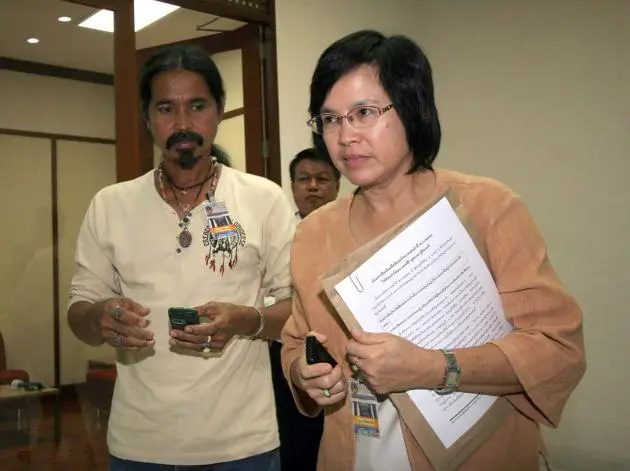
Plaintiff Tossiri Pulnuan said the Flood Relief Operation Centre (FROC) and the Bangkok Metropolitan Administration (BMA) should be held responsible for the failed flood management.
She said she backed the lawsuit by Ayutthaya farmers against the government plan to build floodwalls around industrial estates, despite the Supreme Administrative Court rejecting her plea yesterday for a temporary injunction.
The court yesterday afternoon heard her plea seeking an injunction, aimed at assisting flood victims in Nonthaburi’s Bang Bua Thong district, ordering the FROC and BMA to open the Klong Mahasawat sluice gate in the appropriate proportion to the two agencies’ floodwater management capacity. The plea rejection was on the ground that the flood disaster had ended and the BMA had currently opened the gate 1 metre wide and the canal level was lower than the floodwalls.
The court ruled that there were no grounds to grant the injunction as the flood situation had ended.
Meanwhile, at a seminar yesterday by the Disaster Prevention and Mitigation Department (DPMD), academics urged the government to implement a serious floodprevention plan and argued that the 2.2 million rai (352,000 hectares) of “monkey cheek” floodretention areas were not enough and the construction of floodways was needed.
About 100 representatives from the public and private sectors attended the seminar at Bangkok’s Miracle Grand Hotel.
Tossiri said she hoped that this lawsuit would bring about equality in the treatment of people from Nonthaburi and Bangkok. It would also prevent the government from making unilateral decisions, and instead get them to involve the people in solving problems in their neighbourhoods.
Commenting that the floodprevention plan for 2012 is still based on the government attitude of acting on its own, without seeking local people’s opinions, she said previous problems would reoccur and lead to endless disputes between the government and the people.
She cited as an example the government plan to build floodwalls around Ayutthaya’s industrial estates, without hosting a public forum for surrounding communities to voice their opinions and participate in the decision making. This had led to the lawsuit by farmers and nongovernmental organisations.
She asked why the government chose to protect industrial estates rather than farmlands when Thailand was an agriculture country. She urged the government to clarify that and think more about issues affecting people.
Citing a World Bank estimate, she said the Thai flood inflicted damage of Bt1.4 trillion while loss of income was almost Bt800 billion and growth in gross domestic product shrank to 0.1 per cent.
Arkhom Termpittayapaisith, deputy secretarygeneral of the National Economic and Social Development Board, urged that this year the authorities should not underestimate the impacts of the disaster and focus on practices and tools to check for readiness.
Energy for Environment director Seri Supharathit called for drought and watershortage solutions besides flood prevention and urged that the agencies work on integrating and using existing but unused disaster prevention and mitigation plans. As the previous flood had seen 14 billion cubic metres of flood water, he said the 2.2 million rai of “monkey cheek” areas might not be enough. He said floodways needed to be constructed.
