
Parliament votes to allow Lower House debate on reconciliation


Play
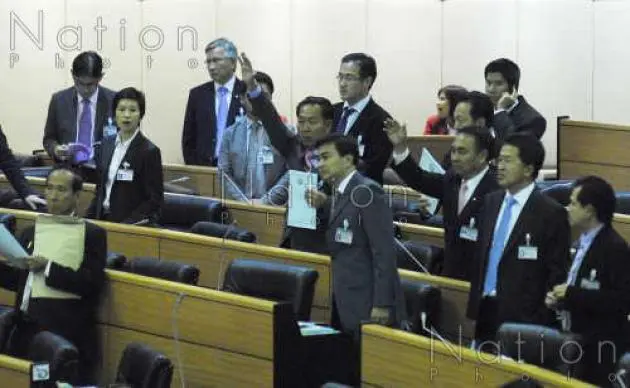
A joint sitting of the Senate and the House of Representatives on Tuesday night voted to allow the Lower House to deliberate a motion on reconciliation proposals in the current legislative House session.
The vote came after a walkout by opposition Democrat MPs who left the meeting chamber in protest after senators and government MPs proposed an early end to yesterday’s debate.
Of the 366 parliamentarians who remained in the chamber following the opposition’s walkout, 346 voted in support and 13 against, with seven abstentions.
The meeting’s chairman, Senate Speaker Teeradej Meepien, declared the meeting closed at 11 pm, shortly before the voting was completed.
Earlier during the heated debate, government and opposition MPs took the floor backing their side’s stance. Opposition MPs called for parliamentarians not to support the motion, arguing that time was needed for the parties involved to consider proposals for national reconciliation. Government MPs said the proposals for national reconciliation should be discussed by the Lower House soon.
The House committee on national reconciliation has endorsed certain reconciliation proposals made by the Parliament’s King Prajadhipok Institute from its research study. Democrat MPs on the panel resigned earlier on Tuesday following disagreement over its report to be forwarded to the Lower House for deliberation.
At Tuesday’s parliamentary debate, Democrat MP Nakorn Machim warned that rushing reconciliation while both sides of the conflict could not agree on issues like amnesty and expunging of post-coup court cases could lead to a new round of violent dispute.
Senior Democrat MPs including Nipon Wisityuthasart, Suthas Ngernmuen, and Witthaya Kaewparadai called for an extended period for parliamentarians to debate whether the current House session should be allowed for the reconciliation motion. Nipon said he saw no urgency in the reconciliation motion, adding that it could be debated in a general session, and not a legislative session.
According to Article 127 of the Constitution, during the legislative ordinary session, the National Assembly shall hold a sitting only in cases of the consideration of organic law bills or bills, the approval of an Emergency Decree, the approval of the declaration of war, the hearing of explanations and the approval of a treaty, the election or approval of a person for holding office, the removal of a person from office, the interpellation and the amendment of the Constitution, unless the National Assembly has passed a resolution, by the votes of more than one-half of the total number of the existing members of both Houses, for considering other matters.
Pheu Thai MP Chonnan Srikaew, who is a government whip, said during Tuesday night’s debate that he supported the idea of extending the debate.
However, Senator Krit Athitkaew from Kamphaeng Phet proposed that the debate be closed. Democrat MP Boonyod Sukthinthai immediately proposed that the debate be continued. Both of them got sufficient supporters.
Democrat MPs criticised the senator, saying that it was unprecedented for a senator to propose an early end to a parliamentary debate.
Government chief whip Udomdej Rattanasathien from the Pheu Thai Party, who first expressed support for the debate to be extended until Wednesday, refused to reassert his stance when requested by opposition chief whip Jurin Laksanavisit from the Democrat Party. This resulted in the meeting chair calling a vote to decide whether the debate should be closed – after the senator insisted on his proposal for an early end to the debate.
Jurin said that it appeared the government chief whip was “fickle” and therefore the opposition would no longer join the debate. Democrat MPs later walked out in protest.
After the walkout, the meeting chair Teeradej called a vote whether the debate should be closed. He made a mistake by announcing that it would be a vote whether to allow the reconciliation motion to be deliberated by the Lower House in the legislative session. He apologised and joked that he was “a bit hot-headed”, drawing much laughter from the remaining parliamentarians in the meeting chamber.
The senators and MPs voted 344-14 to have the debate closed. There were seven abstentions.
