
Ayutthaya farmers worried dykes would affect their operations


Play
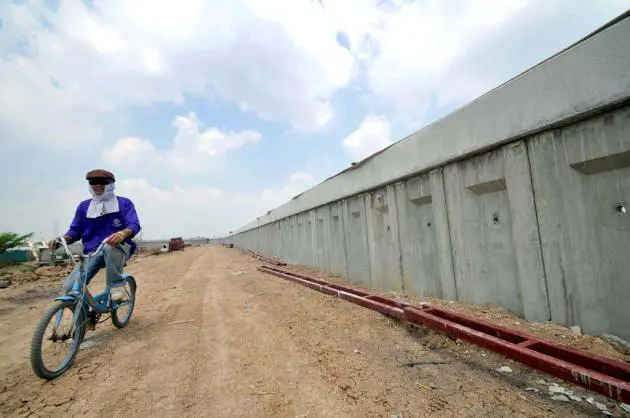
A group of 17 farmers in Ayutthaya province is demanding compensation from the government as the dykes being built around industrial parks in the province to protect against flooding would inundate their rice farms.
They asked government to pay Bt12,000 per rai as compensation.
“We are not opposed to the government’s plan to prevent flooding in industrial parks by building dykes, but we want the government also to pay attention to us. We would be affected by floods because the proposed dykes would raise the water levels and affect our paddy fields,” said Kallayanee Jooprang, who lives in a neighbourhood near Rojana Industrial Park.
She expressed her opinion at a public hearing yesterday that sought the response of local people to the environmental impact assessment report and their recommendations. The EIA report called for the construction of flood barriers around five industrial estates in Ayutthaya – HiTech Industrial Estate, Bang Pain Industrial Estate, Saha Rattana Nakorn Industrial Estate, Rojana Industrial Park and Nava Nakorn Industrial Estate.
Under the 1992 National Environmental Quality Act, if industrial parks want to improve or change the structure of existing dykes surrounding the parks, they need to conduct an EIA and seek additional recommendations and public opinions on the report before securing the permission of related agencies.
More than 500 people, including residents, authorities and representatives from private companies and manufacturers in Ayutthaya, participated in the event organised by Thai Environmental Techniques Co, which was hired by the Industrial Estate Authority of Thailand (IEAT).
The EIA report is expected to be completed next month, after which it will be submitted to the Office of Natural Resources and Environmental Policy and Planning for additional recommendations before it is sent to the IEAT for approval.
Earlier, Kallayanee and 16 of her neighbours asked the AntiGlobal Warming Association to file a lawsuit against Rojana.
“We just want to live peacefully with industry but we also were worried that the dykes would raise water levels and submerge our paddy plantations,” the 55yearold operator of a 12rai (2hectare) rice farm, told the conference.
Another farmer, Namphueng Khonsanbutr, 41, said she wanted the government to pay her Bt12,000 per rai as compensation as her 50 rai of rice farms would be flooded because of the dykes being built around Rojana Industrial Park.
Earlier, the government had paid her only Bt2,200 per rai as compensation but she said it was not enough to cover all the damage her rice farms would suffer.
She said she had invested more than Bt500,000 for her rice plantation. But all the paddy fields were submerged during last year’s floods.
“This is not fair to farmers. Not only industrial parks but we also need the attention of the government,” she said.
Master Sergeant First Class Praneet Treepreuch, a committee member of Ayutthaya province’s Kan Ham Local Authority Organisation, said he supported the building of dykes around industrial parks to prevent flooding as he did not want investors to move out of his village and put their money into other areas.
“We will still have jobs if the investors do not move to other areas,” he said.
Aniruth SasomArth, a hydrological engineer of Team Consulting Engineering and Management Co, said his company had conducted a study to estimate the rise in the level of flood waters caused by the dykes and found that it would not be more than 1 metre.
Chumphon Mohyadee of Thai Environmental Techniques Co said the IEAT had prepared measures to rehabilitate people who will be affected by the dykes.
“We will set up a rehabilitation centre inside the industrial parks to help floodaffected people,” he said.
However, Chalerm Apiwas, headman of Ayutthaya province’s Chai Mongkhon Wattana Community, said it was near the Rojana Industrial Park but no one from the park had provided information and details about the environmental impact of the dykes.
“They just give us general information,” he said.
