
PM urges Japan to back Dawei plan


Play
Yingluck calls for cooperation in huge deep-sea project to be built across the Thai-Myanmar border
Prime Minister Yingluck Shinawatra has urged her Japanese counterpart to support the Dawei deep-sea port and industrial estate scheme across the Thai-Myanmar border.
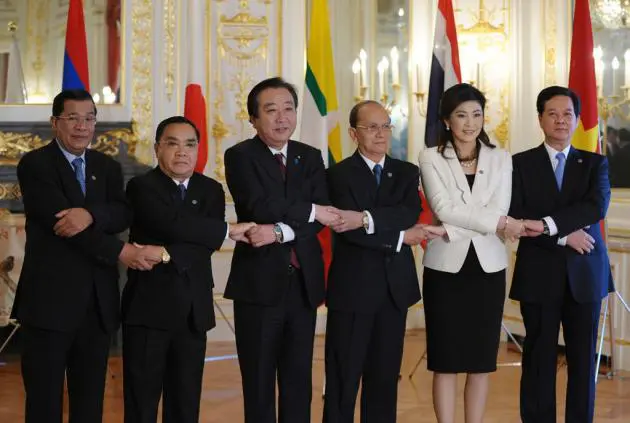
During an official visit to Tokyo to attend the Japan-Mekong Summit, consisting of leaders of Thailand, Laos, Cambodia, Vietnam and Myanmar, Yingluck said Japan was an important partner in this region so the Thai government had sought Japanese cooperation in the major development scheme.
Under a concession granted by the Myanmar government, Ital-Thai group is spearheading the US$8-billion (Bt246 billion) Dawei development, which features a deep-sea port on the Andaman Sea, as well as petrochemical and other industries.
The new Dawei port would also create a “land-bridge” linking Thailand’s Laem Chabang port in Chon Buri province via new highways, which would be built from Bangkok to Kanchanaburi province on the border with Myanmar.
Prime Minister Yingluck said her Cabinet had recently approved state budgets starting this fiscal year to build the new highways to support the Dawei development, which is expected to attract major investors from Japan who want to further expand their manufacturing facilities in Thailand into Myanmar.
The planned Dawei port and industrial estate is situated only about 160km from the Thai-Myanmar border.
According to Yingluck, the scheme will serve as a crucial link between the Andaman Sea and the South China Sea in the near future.
In addition, the PM said the government had sought co-operation from Japan to help formulate training and other programmes to boost the competitiveness of small and medium-sized enterprises (SMEs) in Thailand and other Mekong sub-region countries, including Laos, Cambodia and Vietnam.
These SMEs will face new challenges when the Asean Economic Community (AEC) comes into effect in 2015, resulting in liberalisation of trade in goods and services as well as cross-border investment.
The AEC has a total of 10 member countries, including Thailand, Laos, Cambodia, Vietnam and Myanmar, which are in danger of lagging behind more developed countries such as Singapore and Malaysia, she said.
In regard to Thailand, she said the government had also set aside a budget of $77 million for infrastructure, technical and other assistance programmes for less-developed countries in the Mekong sub-region.
Meanwhile, Yingluck also offered Thai support for negotiations and a peaceful way to end or sort out conflicts in Asia, including the North Korea missile and nuclear programmes and multilateral conflicts over the Spratly Islands in the South China Sea.
She said Thailand could act as a mediator to coordinate talks or other cooperation under a Declaration on the Conduct of Parties in the South China Sea (DOC) protocol under a China-Asean framework, in order to pursue the legally binding Asean-drafted code of conduct (CoC) for contesting parties in the South China Sea.
“Thailand has welcomed China’s constructive approach towards the issue, which would result in an increase of trust between parties concerned,” she added.
“Thailand has concerns over a missile test by North Korea, and although it failed, its impact has reflected the need for the global community to deal with problems which threaten peace in the region.
“As North Korea is now entering a great transition, Thailand has seen a good opportunity to open communication channels and seek good relations with it, in the hope of establishing a collaboration which would hopefully encourage North Korea’s constructive approach towards the nuclear programme issue,” she said.
Speaking of the Spratly Islands issue, Yingluck said the South China Sea was a key transport route, where security and safety in maritime traffic was needed to serve all parties.
Thailand also agreed in principle to seek an increase in the number of seats in the United Nations Security Council, and that more Asian countries should have roles in supporting UN functions and responsibilities.
Yingluck also thanked the Japanese government for its pledge for six billion yen (Bt2.26 billion) over a three-year period beginning next year.
Japanese Prime Minister Yoshihiko Noda said yesterday that Japan would provide five Asian countries in the Mekong sub-region with 600 billion yen in official development assistance over the next three years to help build up infrastructure.
