
Dearth of hospital staff ahead of AEC


Play
Private facilities team up with medical, nursing schools in Kingdom and abroad to train, recruit medical workers
Private hospitals urgently need to recruit medical workers, including nurses and physicians, in a bid to strengthen their businesses and prepare for the intense competition in the healthcare industry expected when the Asean Economic Community (AEC) becomes effective in 2015.
Meanwhile, premium private hospitals have teamed up with medical and nursing schools in countries such as Australia and the Philippines to build the capacity of their medical workers, especially specialists, and strengthen competitiveness.
When the AEC is implemented, people in Asean countries will be able to receive health care services in any country in this region with the same standard. Medical workers will also be allowed to work in any country. This means the demand for doctors at hospitals will increase.
“We are preparing our hospital for the AEC by recruiting more doctors and nurses and ensuring they stay with the hospital,” Yanhee Hospital managing director Dr Supot Sumritvanitcha said.
He said the hospital has prepared itself over the past two years to reduce the impact of the regional integration under the AEC.
The hospital is planing to recruit more than 50 doctors and 200 nurses. The hospital currently has 120 physicians and 500 nurses.
The hospital has imported 50 nurses from the Philippines to work as assistants and translators for Thai nurses and doctors, as they can speak English and communicate with foreign patients very well.
At present, the hospital has 23 translators who can communicate in 15 different languages.
Yanhee Hospital, the country’s leading plastic surgery hospital, has invested about Bt1 billion to build two new buildings, taking the number of beds from 400 to 600. Moreover, it has purchased more high-tech medical devices such as surgical equipment, laser devices and computed tomography (CT) scans.
“We want the hospital to become a one-stop healthcare service. Patients do not need to go anywhere else after receiving treatment and services from our medical workers,” he said.
“Actually we want to be a beauty complex and excellence centre,” he added.
Meanwhile, Bangkok Dusit Medical Services (BDMS), operator of Bangkok Hospital, Samithivej Hospital and BNH Hospital, has recruited more medical personnel including physicians, nurses and pharmacists, to work in its hospitals.
BDMS director and executive adviser Dr Pongsak Viddayakorn said the hospital has also teamed up with other medical and nursing schools in Australia and the Philippines to exchange medical workers and receive training to develop their skills. The hospital has created in-house training programmes to develop skills for its specialists.
Moreover, the hospital has signed a memorandum of understanding (MoU) with Burapha University’s Faculty of Medicine to train physicians. The hospital has also joined with Srinakharinwirot University’s Faculty of Medicine to open an international course for medical students.
“We do not have enough manpower. Moreover, the government has neglected the shortage of medical personnel,” he said.
He said it would likely be necessary to import medical workers from other countries in future.
Some medical schools run by the government are now trying to set up medical units and operate like private hospitals.
“They [medical schools] are now trying to keep their physicians and medical workers to work with them but it is not so easy to do that, because they cannot afford to pay the monthly salaries of medical workers, as private hospitals can,” he said.
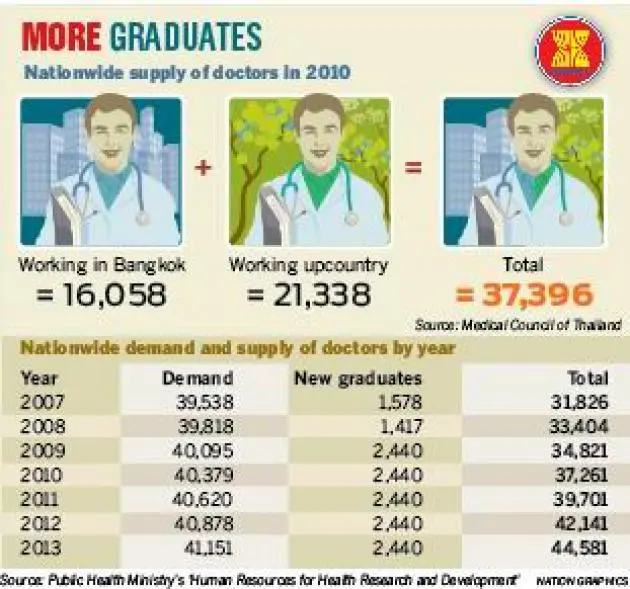
Thailand has 30,681 physicians to provide medical treatment for its over 60 million population. It needs 11,984 more physicians to fill the shortage.
“We need to control and balance the number of physicians working in private and state hospitals,” said Health Service Support Department director-general Dr Somchai Pinyo Phonpanich, who oversees the AEC adaptation plan for the healthcare sector.
The department is drawing up a
plan to prepare the public health sector for the AEC in the next three years. Under the plan, the department will develop all related regulations to leverage healthcare service standards, especially the standard of healthcare units and practitioners.
Meanwhile, Medical Council of Thailand secretary-general Dr Samphan Kongrit said the council has teamed up with the Public Health Ministry to produce more physicians to resolve the doctor shortage.
At present, the ministry can produce 2,000 doctors a year. It is expected there will be an additional 10,000 physicians trained in the next five years.
Moreover, the council has drawn up a plan to encourage educational institutes, especially medical schools, to introduce an international medical curriculum for foreign students.
He said the plan is aimed at pushing Thailand as a medical education centre in Asean and a generator of revenue for the country.
