
Global illicit drug causes heavy financial burden : UNODC


Despite a global illicit drug use and production situation it describes as "stable", the report released today by the UN Office on Drugs and Crime (UNODC) draws attention to the "heavy financial burden" and human costs of illicit drug use in countries
Noting that less than one in five persons needing treatment for illicit drug use receives it, the UNODC World Drug Report 2012 said that up to US$250 billion (nearly 0.4 per cent of global GDP) is needed to cover illicit drug treatment-costs worldwide. It also estimates that productivity losses from drug abuse cost societies 0.3-0.9 per cent of GDP annually.
“Heroin, cocaine and other drugs continue to kill around 200,000 people a year and contribute to the spread of HIV, shattering families and bringing misery and insecurity,” says Mr. Yury Fedotov, UNODC Executive Director.
The report is being formally launched in New York at the UN General Assembly. “Illicit drugs fuel crime and insecurity. They undermine human rights and pose significant public health risks.”
Around 230 million people, or 5 per cent of the world’s adult population (aged 15 to 64), are estimated to have used an illicit drug at least once in 2010, according to the Report. Problem drug users, mainly heroin- and cocaine-dependent persons, number about 27 million, equivalent to roughly 0.6 per cent of the world adult population, or 1 in every 200 people, the Report notes.
The annual publication aims to provide an overview of the world’s drug situation in terms of illicit cultivation, production, trafficking, and abuse with the latest data available.
The source of the data is mainly from the Annual Reports Questionnaire system used by most governments and coordinated by UNODC. The World Drug Report is launched annually on June 26 to mark World Drug Day.
The Report was launched in Bangkok at the Foreign Correspondents Club of Thailand (FCCT) by Gary Lewis, UNODC Regional Representative, East Asia and the Pacific. "Increases in trafficking in methamphetamines and other illicit drugs coupled with the significant increase in opium poppy cultivation reflect growing human security threats to the region," said Lewis.
In addition, he noted that amphetamine-type stimulants (ATS) are now the second most popular illicit drug after cannabis.
In terms of a law enforcement response, Lewis urged the need to focus more on kingpins and their white collar accomplices. “We need to ‘follow the money’ – the proceeds of crime – and do a better job to counter money laundering. Finally we need to empower frontline law enforcement agencies with proper knowledge and equipment”, Lewis said. Looking at the demand side, he urged the region to “adopt evidence-based prevention strategies and – when treating people for drug use – which is a chronic relapsing disorder – we must focus on effective community-based treatment and move away from the focus on compulsory centres.
According to the Report, the two most widely used illicit drugs by adults aged 15-64 around the world – and in Asia – remain cannabis, with up to 224 million users worldwide, and amphetamine-type stimulants (ATS), such as methamphetamine, with up to 52 million users estimated. These are followed by opioids (mainly heroin, morphine and non-medical use of prescription opioids), “ecstasy”, opiates (opium and its derivatives) and cocaine.
Although cannabis consumption is stable, ATS seizures worldwide more than doubled between 2008-2010 to 45 tonnes (up from 21.5 tonnes in 2008). This is due to significant seizures in East and South-East Asia as well as Central America.
In East and South-East Asia, methamphetamine use, particularly crystalline methamphetamine is reported to be widespread. Crystalline methamphetamine is now the most commonly used drug in Brunei Darussalam, Japan, the Philippines and the Republic of Korea.
There is evidence of emerging and expanding heroin markets in Asia. In 2010, an increase in heroin users was observed in Indonesia, Singapore and Sri Lanka. Slight increases in heroin seizures were reported in Indonesia, the Lao People’s Democratic Republic, Malaysia and Singapore.
Global opium production rose to 7,000 tonnes in 2011, up from the low levels of 2010, when plant disease in Afghanistan wiped out almost half the crop. In the absence of this blight and with cultivation at nearly the same level, the amount of opium produced in Afghanistan increased by 61 per cent, from 3,600 tonnes in 2010 to 5,800 tonnes in 2011.
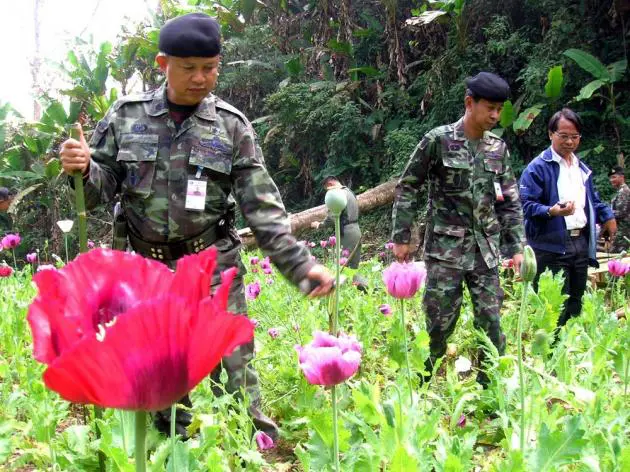
Myanmar remained the world’s second largest poppy-crop grower and opium producer after Afghanistan, with cultivation up by 14 per cent in 2011. According to UNODC, Myanmar currently accounts for 23 per cent of global illicit poppy cultivation, and 9 per cent of global opium production. The Lao People's Democratic Republic (PDR) saw an even steeper rise in cultivation of 38 per cent although total cultivation remains low compared with global estimates. Myanmar’s potential opium poppy production is estimated at some 610 tonnes and Lao PDR’s at around 25 tonnes.
From 2010 to 2011, poppy crop cultivation in South-East Asia jumped 16 per cent from some 41,000 hectre to almost 48,000 hectre. Overall, cultivation has doubled in South-East Asia since 2006. UNODC estimates that 246,000 households are involved in opium cultivation in Myanmar, with 91 per cent of opium cultivation occurring in Shan State.
“Alternative development is the key to reducing illicit drug crop cultivation and drug production,” Lewis said. “To support the development of peace and security in Shan – and throughout our vast, dynamic region – we must banish the illicit drug economy on which so much insecurity rests. Eradication alone is not the solution - what is now needed," he said, "is for countries in the region and international donors to invest in the development of licit livelihoods for poor, poppy farming communities."
While illicit drug use is overall much higher among males than females, the non-medical use of tranquillisers and sedatives is higher among women, as shown where data are available (South America, Central America and Europe). Worryingly, the abuse of tranquillizers and sedatives can develop into a lifetime habit, especially among women.
