
Young inventors give hope for the future


Play
Simple devices from region solve everyday problems
Amateur inventions created by the small hands of young inventors from Asian countries may not look professional at a recent international exhibition, but when we discovered more about the creations we felt hope that the region would develop in the future.
Most of the creations were not developed with complicated technology, but the many questions that visitors put to the students who made them, to find out more about the inventions showed how much they were interested in their creations.
Why were the inventions interesting, even though the young inventors did not use complicated technology?
With unexpected ideas, many inventions have been adapted from things seen in everyday life and also some commodities or personal items like shoes and walking canes have been equipped with technological tools so they can be multifunctional or do more advanced functions.
“How can they design and create them?” And “What a good idea!” were comments heard from many visitors who went to the eighth International Exhibition of Young Inventors 2012 (IEYI 2012), which ended yesterday at the Bangkok International Trade and Exhibition Centre.
A device named “Nutty-Notty”, which is a tailored socket that connects a hydraulic jet and a ratchet spanner, created by Afifah Bt Husain, a Malaysian student, can help motorists, especially lady drivers, easily loosen screws on tyres. And at the same time, they can lift the car up for easy removal of the flat tyre. The device also helps them tighten the screws easily.
Afifah said her device would be sold in markets in Malaysia soon. A company was working with her to manufacture it commercially. The price would be around Bt800 each.
Many of the inventions created by Thai students could support the country’s agricultural development, like a cassava stem cutting machine; a plant pot moulding device; a lump rubber collecting device; a papaya grating machine; and a machine to cut pineapple leaves. Most of the creations by Filipino students can be used to protect the environment.
More than 300 youngsters from Thailand, Japan, Malaysia, Indonesia, Hong Kong, the Philippines, Singapore, Taiwan and Vietnam showcased more than 200 creative creations at IEYI 2012. The age of the young inventors ranged between six and 19.
The theme for IEYI 2012 was “Future Inventors, Future World” with a display and competition divided into five categories: local sustainability, climate change (preparedness and mitigation), green products, technology from nature, and recreational or educational products.
Grand Awards were given to Door Stopper Hinge by a student from Hong Kong, the Great Wall of Plastic by a Malaysian student and Nursing Care Machine (lifter/mover) by a Japanese student.
Malaysia got seven gold medals. Taiwan also bagged seven golds. Thailand won five, the Philippines four, Japan three, Hong Kong two, Indonesia two and Singapore one gold.
Malaysia also won the most silver medals (13), followed by Taiwan with 10 and Thailand with seven. Thailand won the most bronze medals with 18, followed by Malaysia (14) and Taiwan six.
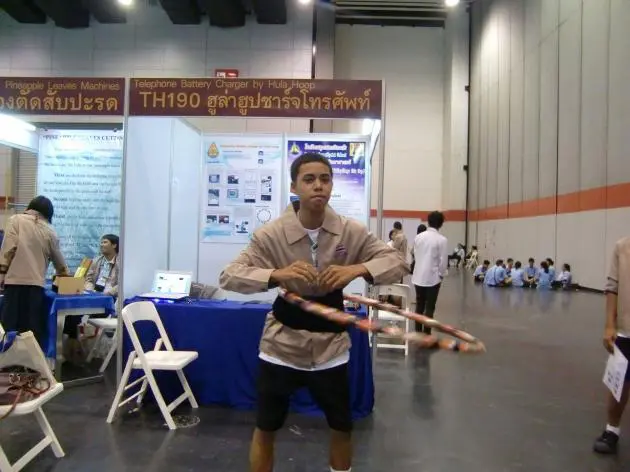
The five inventions by Thais that won gold medals included a mobile phone battery charger by hula hoop, a fly trap using water as an eliminator, a three-in-one power generator, a water garbage collector using solar energy and a parkia speciosa hassk flower pollination device.
Some young inventors told The Nation they wanted their creations to be developed and used as solutions to problems of their own country. Doing so would be more meaningful and helpful than just providing them a chance to compete and win awards.
Soraya Nabihah Bt Shamsul Azri, a 16-year-old young inventor from Mara Junior Science College in Malaysia, who created a mobile integrated table chair, said: “At this exhibition, there are many solutions to different problems faced by many countries, like pollution. I agree that our inventions here are not as good as those created by private companies, but if the governments of our countries get our ideas or what we are trying to recommend to them (through the inventions), they just have to help upgrade the inventions.
“Why don’t they take our ideas or inventions to improve or upgrade and then use them to solve problems? The solutions are here.”
She said she wanted the governments to listen to youngsters’ ideas and consider if they could develop the ideas to create useful things.
“I want the Thai government to educate not only students, but also the general people to know different technological tools and technology. So, people who have good ideas see different examples of changing ideas to create simple inventions that could be sold in the market,” said Apisit Wannarangsri, 16, from Samut Sakhon Witayalai School, who created a mobile-phone battery charger by hula hoop.
“Many students have creative ideas of inventing creations, but with limited budget, the creations are not as good as we expected. We need financial support from government agencies and private companies. If they give us this support, we can go further. Probably, many inventions could be improved for commercial purpose,” he said.
Tai Yui Fung, 15, from Lingnan Dr. Chung Wing Kwong Memorial Secondary School from Hong Kong who invented safety window cleaner brush, said design and technology in Hong Kong that helped create devices to facilitate people’s lives were good now. But Hong Kong should keep improving its technology, especially computers as they helped programmers write better programs or software to control and develop robots.
