
Fishing, clearing blamed for south swamp fires
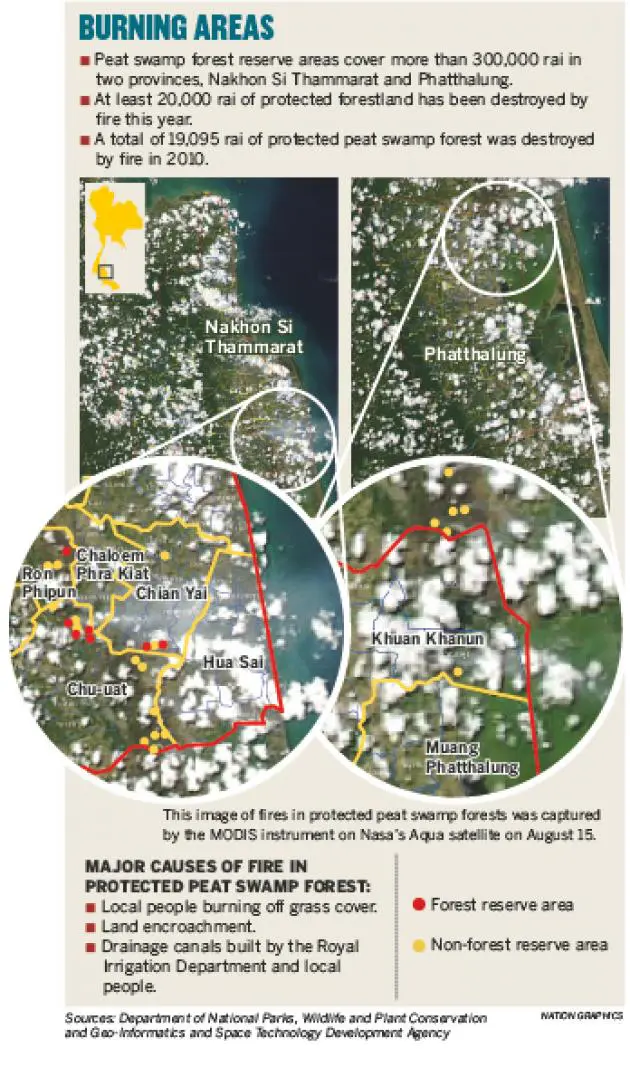


Villagers burn grass to catch fish; 20,000 rai destroyed
Ordinary and ill-intentioned agricultural activity by local people – some of them just burning a field of dry grass to catch fish hidden in the mud – caused a huge fire in protected peat swamp areas in the South, a forest fire-watch agency said yesterday.
At least 20,000 of 300,000 rai of protected forest in Nakhon Si Thammarat and Phatthalung have been destroyed by blazes that authorities say were lit by locals wanting to fish in the bogs.
“They burned the grass cover so they could easily catch fish hidden in the mud,” Chai Suwanchart, chief of the Wildlife Non-hunting Area Office, said.
Chai admitted his officials had allowed local people to catch fish in the peat-swamp forest.
Most locals go to the forest to catch sheatfish, like snakehead fish and catfish, which hide in the mud covered by grass during the prolonged dry season in southern provinces.
“We have been asking local people to cooperate and not to burn grass in the peat-swamp forest during the dry season as it could damage protected forest areas but no one listened to us,” he said.
But some locals had also started burning their farms and palm plantations. These fires then grew and spread to the protected peat swampland nearby. After the forest reserves were damaged, they would occupy the land.
Forest authorities said over 10,000 rai of peat-swamp forest had been destroyed and occupied by local people for palm oil plantations and other agricultural development.
Chai said his agency found 33 copies of land ownership deeds for 70 rai of peat-swamp forest were fake Sor Kor 1, and 29 copies of Nor Sor 3 Kor land ownership deeds for 1,269 rai of protected forest land were illegally issued.
“We found that four big oil palm plantation operators had occupied about 4,000 rai of the encroached forests. They claimed that they held legal land ownership documents such as Sor Kor 1, Nor Sor 3 and Nor Sor 3 Kor,” he said.
To date, there are many land uses including palm oil plantations in 70 villages in Nakhon Si Thammarat near the peat-swamp forest reserve areas.
The large illegal plantation has degraded the peat swamp forest and caused dry weather over the land.
There were many factors that caused fires in protected peat-swamp forest in Nakhon Si Thammarat and Phatthalung provinces.
One of the major causes of wildfire in these provinces was the prolonged drought that made the forest especially vulnerable as the water was down to 20 centimetres underground.
Moreover, the local office of the Royal Irrigation Department had opened the water gate of a canal to drain water from the peat-swamp forest to the sea as it wanted to prevent palm oil plantations and local people’s homes from flooding.
National Parks chief Damrong Phidet is due to visit areas damaged by fire in Nakhon Si Thammarat today to try to solve the wildfire problem in the peat-swamp forest in the longer term. He will talk with relevant agencies, including Royal-initiated Development Project and Agricultural Land Reform Office, to find long-term ways to control fire in the forest and stop land encroachment.
Sanit Aksornkaew, of the Thailand Environment Institute, said the DNP should send officials to collect samples of soil and water to study physical changes in the peat-swamp forest, as the forest fire would increase alkalinity, which affects biodiversity and the growth of plants and animals.
