
Judiciary urged to block demolition


Play
Fine Arts Dept says building to be torn down is of historical significance
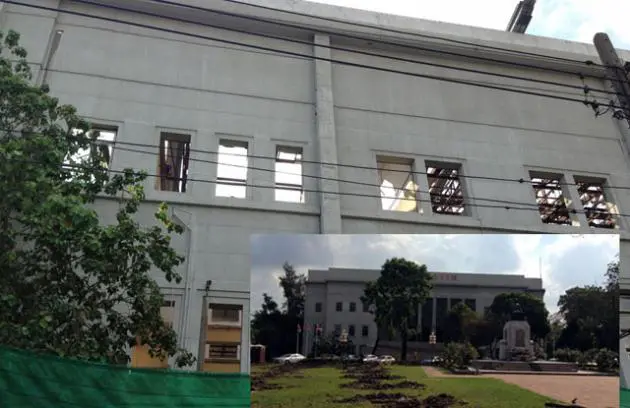
The Fine Arts Department has filed a petition with the Supreme Court to suspend the demolition of a building of significant historic and architectural value in the court’s compound.
If the court decides to ignore the petition, it could be violating the 1961 Historic Buildings & Historic Artefact Act, department director-general Sahawat Naenna said yesterday.
However, former Supreme Court president Sawat Chotipanich questioned the department’s move.
“The department had been involved in the process to construct the new building from the very beginning and had agreed that old buildings in the compound had to be demolished. Why has it suddenly decided to go against it now?” he asked.
He said the Rattanakosin Committee was established when Prem Tinsulanonda was prime minister and the panel came up with the idea of constructing a new office for the Supreme Court.
“Besides, the committee comprises department officials. There are no representatives of the court,” Sawat pointed out, adding that the Fine Arts Department had reviewed the design of the new building and approved it.
Another source at the court said the contractor might decide to sue the department if it continues trying to delay the construction.
“In fact, when the foundation-stone-laying ceremony for the new building took place in 1992, representatives of the Fine Arts Department were also present,” this source said.
Sawat said a new building was necessary because the courts now are overcrowded and lack adequate infrastructure.
Legal protection
However, Sahawat has been saying that at least two buildings inside the court’s compound on Rajdamnoen Avenue have legal protection and must be conserved. He said the demolition of one of the buildings could constitute a legal offence.
“Violations in such cases are punishable by up to seven years in jail and/or a fine of up to Bt700,000,” Sahawat warned.
While the building in the compound has not yet been declared in the Royal Gazette as a historic building, it has the legal status of a historic structure under the 1961 Historic Buildings Act, he said.
According to the act, any property constructed a long time ago that has artistic, historic or archaeological value shall be considered a historic building pending a review of its importance and significance.
Sahawat said there were some 8,000 structures in Thailand that could be considered historic under this definition, but the Fine Arts Department has only finished registering just over 100 buildings because the review process takes time.
“Even though the building in the Supreme Court compound is not yet officially registered, it is definitely a historic building,” he said.
Sahawat complained that his department had told the Supreme Court several times that the building, which previously housed the Southern Bangkok Criminal Court, must be preserved.
“I have checked with my predecessors,” Sahawat said.
He added that any modification or demolition of the historic building without prior approval was a legal offence, although the violation carried a lighter punishment than modifying or demolishing a historic building that has already been registered.
The Fine Arts Department has the mandate on whether to approve such changes or demolition, he said.
Sahawat mentioned the law and legal punishment a day after Court of Justice spokesman Sittisak Wanachakit announced that the demolition of the building would go ahead.
While the Fine Arts Department insists that two buildings in the court’s compound are under legal protection, Sittisak has made it clear the court will preserve just one and that the building that once housed the Southern Bangkok Criminal Court must be brought down.
According to Sittisak, only the oldest building in the compound – the one that housed the Office of the Judiciary – will be preserved.
The demolition of the historically important building in the court’s compound has caused a public uproar, and the Association of Siamese Architects under Royal Patronage has also expressed concerns about it.
