
Court will rule on charter bid


Accepts petition from senator; stops short of issuing injunction
Though the Constitutional Court yesterday agreed to rule on the moves to change the charter’s Articles 68 and 237, it decided not to order an injunction against the amendment process.
However, the court might eventually rule to overturn changes in the future.
Senator Somchai Sawaengkarn, a member of a group of 40 appointed senators, on Tuesday sought a court ruling and an injunction against the amendment of Articles 68 and 237.
The court yesterday voted 3 to 2 to accept the petition. Attending the court’s meeting yesterday were only its president, Wasan Soypisudh, and four justices – Jaran Pukditanakul, Charoon Intachan, Puphot Khaimuk and Udomsak Nitimontree. Four justices were away on a trip abroad.
The court reasoned that there was not sufficient urgency to warrant the issuing of an injunction.
The charter amendment bill seeks to change Article 68 to restrict people’s right to seek Constitutional Court rulings by requiring their petitions be submitted through the Attorney-General’s Office. The bill also seeks to amend Article 237 to do away with the penalties of political party dissolution and political bans against party executives.
In his petition, Somchai claimed that Parliament President Somsak Kiatsuranont had abused his authority and violated the charter by allowing the debate on the amendment bill to proceed. He also alleged that 311 coalition MPs and senators violated the charter by supporting the bill, which would run against the court’s decision that people could invoke Article 68 to seek a ruling from the court directly.
Democrat MP Wiratana Kalayasiri, head of the party’s legal team, warned that the MPs and senators who voted for the bill in its first reading might be impeached if the court equates the amendment of Article 68 with an attempt to overthrow the democratic system of government.
The opposition Democrats were compiling information and transcribing the tapes of the debate and interviews of leading Pheu Thai members, including Chaturon Chaisang, to consider whether to file a complaint to the court, he said.
Chaturon had said Parliament could proceed next with passing the amendment bill for Article 291, which seeks to write a new charter and is pending its third reading, right after the Article 68 amendment bill was passed, he said.
Earlier, the Constitutional Court invoked Article 68 to accept a citizen’s petition against the Article 291 amendment bill and ruled that the rewriting of the entire charter could not go ahead without a public referendum.
If the Democrats opt to take legal action, the Constitutional Court may consider its petition together with Somchai’s petition, Wiratana added.
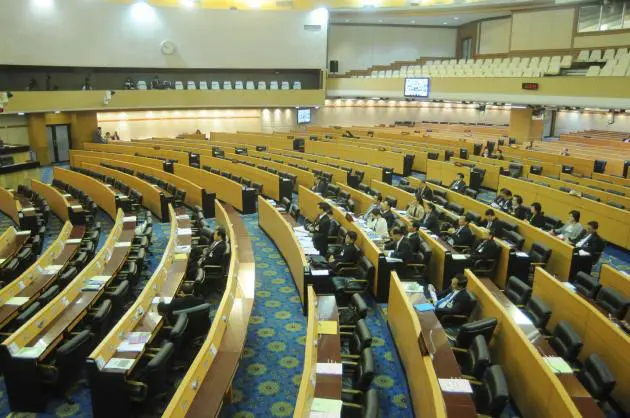
Prior to the court’s announcement yesterday, the Parliament had turned into a platform to grill the Constitutional Court on the third day of the charter amendment debate. Many government MPs and senators warned that the court’s decision to halt the charter-amendment process might result in a new round of political chaos.
The court was scrutinised for its ruling last year on the parliamentary motion to change Article 291, which allows charter amendment, but only on an article-by-article basis. Supporters of the amendments want a new charter to be drafted, claiming that previously the court had used Article 68 to issue a ruling, which caused the bill to be stuck in Parliament pending for a third reading.
PHEU THAI DISSOLUTION FEARS
Pheu Thai MP Niyom Wechkama said he was concerned about what the Constitutional Court had to say about charter amendment. “I am worried because Pheu Thai may face dissolution again, and if this happens, I don’t know which party I would go to,” he said.
Pheu Thai MP Witthaya Buranasiri said critics of charter change had erred in suggesting that the focus should be on resolving the rice-pledging scheme instead of also spending time on charter amendments. He said the government and the legislature had completely different tasks, pointing out that the charter debate fell under the legislative purview, while the rice-pledging scheme came under the government.
“The legislature’s mandate is to legislate,” he said.
The parliamentarians were speaking at a time when Senate Speaker Nikom Wairatpanij was chairing the meeting and most of the opposition Democrat MPs had walked out.
Meanwhile, Senator Direk Teungfung, one of the sponsors of the charter change bill, said that the Constitutional Court had little ground to accept a challenge to the bill.
“I don’t think the high court will review the proposed amendment of Article 68,” he said, referring to the provision protecting democratic rule. The legislature had a mandate to revise the charter as necessary, he said.
The bill was limited to changing the channel through which a petition can be filed for the prosecution of persons trying to overthrow a democratic government, he added.
COURT ‘SHOULDN’T INTERFERE’
Pheu Thai MP Cherdchai Tantisirin said the Constitutional Court should stay out of parliamentary deliberation on the bill and remember the outcry raised over its previous interference in the legislative process.
Outside Parliament, Pheu Thai Party member Singthong Buachum yesterday filed a petition with the Constitutional Court to overturn the senators’ request for a court injunction pending the ruling on whether to suspend the amendment of Articles 68 and 237.
Singthong said the Parliament has the right to amend the charter article by article as recommended by the Constitutional Court which issued a ruling in July 2012 over the amendment of Article 291. He said if the court accepted Senator Somchai’s petition and rules to suspend the charter amendment, Parliament will be dealt a blow by a constitutional impasse as happened with the move to amend Article 291.
Meanwhile, Prime Minister Yingluck Shinawatra yesterday called on the Constitutional Court to help break the impasse, saying the country could not move ahead if the law of the land was not amended to promote justice, democratic rule and international confidence in the country’s legal system.
“Thailand is preparing to enter the integration of the Asean Economic Community. Many countries have revamped their laws to ensure that they meet democratic principles and the rule of law, which has helped create confidence in their countries. I believe every sector will help find a way out of the country’s legal stalemate,’’ she said.
