
International law the only solution to Preah Vihear


Play
The nationalist fervour being used to whip up rallies in the border province of Si Sa Ket will not help Thailand and Cambodia settle the longstanding conflict over the old Hindu temple of Preah Vihear. Rather than the cool approach needed, the hotheads ar
A group of nationalists calling itself Dharma Yatra Pitak Siam is provoking Si Sa Ket residents and activists in its network to stand up to the International Court of Justice (ICJ), which will open its next hearing on the Preah Vihear case on Monday.
The group comprises the same persons who associated with the conservative yellow shirts to open old wounds in Thai-Cambodian relations years ago.
For many Thai nationalists, the Preah Vihear case is a sore that has festered since 1962, when the ICJ ruled that the temple belonged to Cambodia. At the time, Thais were told by the then royalist-nationalist regime that the temple justly belonged to Thailand but that the world court, which was dominated by Westerners, had been unjust in its ruling to hand it over to Cambodia.
Conservative intellectuals implanted the mistaken notion that Thailand had reserved its right to reclaim ownership of the Hindu temple and that the world court had no jurisdiction in the case.
Others, such as Dharma Yatra’s leader Samarn Sri-ngam, went even further, calling on the government to reactivate the defunct 1941 Tokyo Convention, which allowed Thailand to annex, by force, Preah Vihear along with other parts of Cambodia during World War II.
Ultra-nationalism was at the core of the Pan-Thailand policy of Field Marshall Plaek Pibulsongkram’s administration during the first half of 20th century. That nationalistic ideology was then phased out after the Cold War.
Conservatives, led by yellow shirts, brought about its rebirth in 2008 when they launched their crusade against their enemy, the followers of former Prime Minister Thaksin Shinawatra.
They created a discourse whereby the territory had been lost by Thaksin’s proxy government under Samak Sundaravej, which offered its support for Cambodia’s plan to list Preah Vihear as a World Heritage site in 2008.
The previous government under Abhisit Vejjajiva, which enjoyed strong support from conservative royalist-nationalist groups, had maintained a nationalist policy against Cambodia. Abhisit made strenuous efforts against the listing of the temple as a World Heritage site. Border skirmishes around Preah Vihear that broke out during the Abhisit administration strained relations between the two countries badly, before Phnom Penh decided to take the case back to the world court for an interpretation of the 1962 judgement.
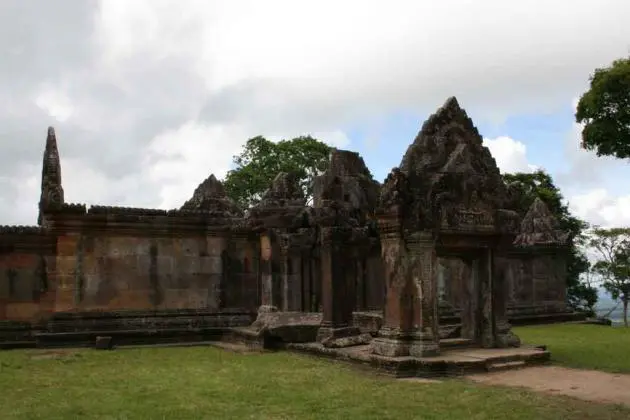
The ICJ had ruled in 1962 that Preah Vihear was situated in territory under the sovereignty of Cambodia. Thailand has since argued that the court ruling only covers the temple, while the adjacent area belongs to Thailand. The Thai government in 1962 relinquished some 250,000 square metres of the temple’s land to Cambodia but maintained its claim on the surrounding area. But Cambodia then wanted the land claimed by Thailand for a World Heritage-site buffer zone.
From Monday to Friday next week, both sides will present facts, evidence and legal grounds to back up their claims at the ICJ in The Hague, before the final judgement is delivered late this year. Thailand and Cambodia have assigned their top legal teams for the court battle. Both teams can expect moral support from their compatriots back home, but the actions of nationalists in rejecting the court’s jurisdiction or in occupying the disputed territory are overkill and unnecessary.
Let the battle be fought on legal grounds alone. Nationalism and politicisation of the dispute will never bring a genuine solution for this international conflict.
