
Govt downplays ICJ query


Play
Experts praise Thai team's performance at Preah Vihear hearing
The question raised by Judge Abdulqawi Ahmed Yusuf after Wednesday’s International Court of Justice (ICJ) hearing on the “vicinity” of Preah Vihear Temple reflected a personal interest of the judge, but sent no significant signals regarding the case, Foreign Minister Surapong Towichukchaikul said.
The judge asked Thailand and Cambodia to define the vicinity of Preah Vihear on maps or graphics of the area and show it to the court.
The court required a reply in written form from both sides by April 26, and the parties would have to submit responses to each other’s definitions by May 3.
Some observers said the judge’s question sent a signal that the court was willing to address the issue of the status of the temple’s vicinity, and showed an inclination to accept the case for interpretation as requested by Cambodia.
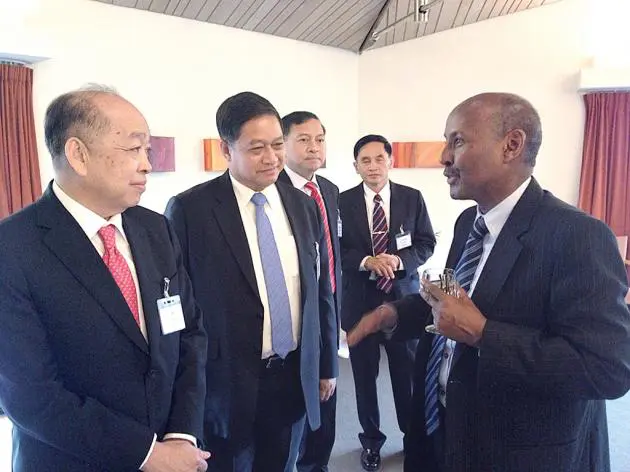
Surapong said he asked Judge Yusuf in person during a reception party after the hearing on Wednesday about the significance and implications of the question.
The question reflected the personal interest of Judge Yusuf, not of the court’s panel, but the judge would circulate the replies from both sides to the other 16 members of the court, Surapong said.
Thai agent Virachai Plasai said it was unusual for a judge to raise a question after a hearing session had ended, and to request answers in written form. Previously, the court or judges would ask questions during the hearing session and demand an immediate answer. “But we should not panic over the judge’s question. It implies nothing for the whole case,” Virachai told reporters.
Thailand and Cambodia are in conflict over their interpretation of the 1962 judgement by the ICJ that Preah Vihear Temple is situated in territory under the sovereignty of Cambodia. Under the judgement, Thailand was ordered to withdraw troops from the temple and its vicinity.
Cambodia has asked the court to clarify that the vicinity of the temple should be delimited by the boundary line that appears on the 1:200,000-scale map known as Annex I. Thailand argues it left the “vicinity” of the temple 50 years ago as ordered, and that the area whose status Cambodia wants the court to interpret is not same as that referred to in its previous judgement.
Political scientist Panitan Wattanayagorn said that from a legal standpoint, Thailand was at an advantage after questions were raised over the accuracy of documents put forward by Cambodia, as well as in jurisdictional issues, which he said clearly favour Thailand. “But the [ICJ] does not rely solely on testimony and documentary evidence in making its rulings. It also uses outside factors including international relations and other global issues in reaching conclusions and verdicts,” he added.
He said the court has three main options: to rule that it has no jurisdiction, which would fully benefit Thailand; to endorses Cambodia’s claims based on its questionable maps, which would be the worst outcome for Thailand and result in immediate loss of territory, and possibly subsequent border clashes; or to make no ruling affecting territory or the border, while issuing certain instructions for both sides to follow in order to end the issue peacefully.
Panitan, a Chulalongkorn University lecturer, pointed out an important event at the trial on Wednesday, in which a judge sought verification of Preah Vihear Temple’s precise location, asking for both sides’ accounts. “Many deem this a crucial point in the whole trial, signalling that the court intends to reach a conclusion.”
The first option would mean that Cambodia’s use of the 1:200,000-scale map would no longer be valid. But it would also result in a prolonged stalemate in which both countries are barred from entering the temple compound and the 4.5 square kilometres of land around it, and that further development of the temple as a World Heritage site would be put on indefinite hold, Panitan said. “This option will result in [the preservation of] the current situation and possibly future border clashes.”
The most likely option is the third, in which the ICJ issues a ruling aimed at a peaceful resolution giving both sides a middle ground – this is the role of the ICJ in modern times, according to Panitan. But Thailand still has issues with the matter.
Panat Tasneeyanond, a former dean of Thammasat University’s Law Faculty, said, “I think Thailand holds an edge [over Cambodia] in terms of the forcefulness of its statements and replies.” He said it was a close fight and Thailand did well in presenting its version of the map of the area.
Weeraphat Priyawong, an independent international lawyer who has experience at ICJ trials, said Thailand’s handling of the temple issue was better than Cambodia’s, covered and presented more details, and was more complete.
“The Thai team used scientific evidence and solid geological proof that showed ... the 1:200,000 map [used by Cambodia] would be hugely inaccurate,” he said.
