
Tests continue to determine contamination in Ao Phrao


Play
Though the affected beach area in Koh Samet's Ao Phrao has recovered to some extent after last month's oil spill, the Pollution Control Department (PCD) is still investigating the possibility of hazardous contamination under the sand in the tainted areas.
Meanwhile, another test run by the department to study the quality of seawater found that the level of Total Petroleum Hydrocarbon (TPH) in samples of seawater in Ao Phrao and Ao Look Yon, collected on Thursday, exceeded acceptable standards.
“We really need to know what lies beneath the sand?”Anukoon Suthapan, director of the department’s Emergency Response and Remedy Division, said.
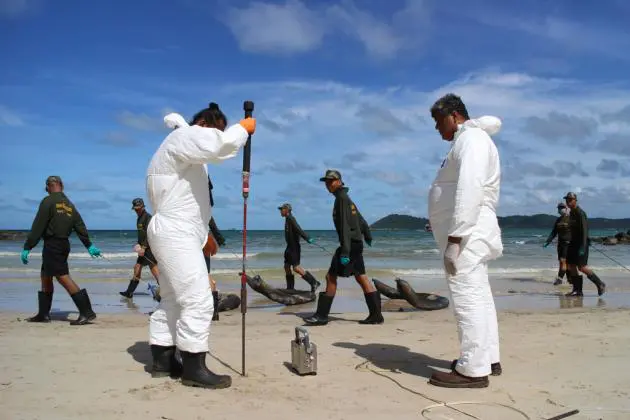
Anukoon is leading a group of six pollution inspectors to collect samples of sand from the Ao Phrao beach, which was affected by the oil spill since July 28.
Ao Phrao is widely regarded as the top destination in Rayong province’s Koh Samet for tourists to enjoy the beach, coral reefs and the sunset.
Three weeks ago, the sandy beach and seawater surrounding Ao Phrao were sullied by the black oil spill. However, the light brown colour of sand and the turqoise blue seawater are slowly re-emerging through the efforts of numerous soldiers and spirit volunteers who were deployed to clean up the tainted beach and seawater.
To ensure the beach is free of contamination, the department is conducting a study to measure the level of volatile organic compounds (VOCs) and TPH on the beach, which is the habitat for the marine benthos.
Inspectors wearing white biohazard suits went to the affected site yesterday morning to collect sand samples from the 400-metre-long beach.
They had only three hours in the morning to finish collecting the sand samples before high tides began at noon.
Iron pipes have been used to drill about 20 metres deep into the sand and electronic devices are being used to measure the level of VOCs and TPH.
The inspectors need to collect sand samples from 30 spots on the beach at Ao Phrao to study the contamination levels.
About eight samples of sand will be tested to check for TPH contamination.
In the preliminary test by the rapid measuring device, Anukoon said the inspectors found that the level of VOCs was measured at 0.2 part per million (ppm), which is a very low level.
At Ao Phrao, hundreds of soldiers are using small spoons to remove the remaining oil and begin the process of sand rehabilitation.
They are also using chemical absorbent pads with wooden sticks to remove traces of oil from the beach.
Meanwhile, the department’s director-general, Wichien Jungrungruang, said the results of the third test on contaminated seawater around Koh Samet caused by the oil spill have shown that the level of TPH in Ao Phrao and Ao Look Yon exceeded the acceptable standard of 0.5 microgram per litre.
The result showed that as of Thursday, the level of TPH in Ao Phrao was measured at 5.7 microgram per litre and it was 1.3 microgram per litre at Ao Look Yon.
“Visitors are being told to avoid swimming in these two areas until the test results show the seawater quality is safe,” he said.
Meanwhile, the latest test result showed that the level of mercury in Ao Tub Tim and Ao Phrao has fallen to below the acceptable standard.
The department will, next week, conduct its fourth and fifth tests to study the quality of seawater.
