
Students visit Samet to see things for themselves
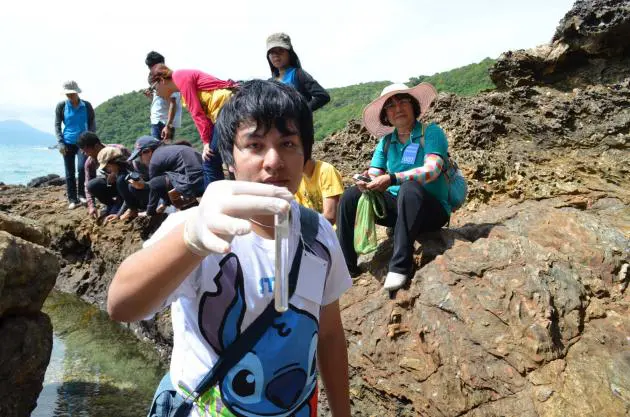


A MONTH after more than 54,000 litres of crude oil leaked into the sea off Rayong and washed up at Koh Samet, some 20 biology students and lecturers from Silpakorn University's Faculty of Science decided to go on an on-site study trip to the island.
“I want to see what really happened because we only get partial truth from news reports. I believe that even after the clean-up, the oil slick will continue having an impact,” third-year student Thamonwan Ditheepeng said.
As a student of science, she said she wanted to collect scientific data so she could tell people the truth and advise them on proper rehabilitation methods.
The oil leaked from a PTT Global Chemical pipeline on July 26 in the area off Rayong.
Asst Prof Dr Renu Vejaratpimol, who is leading the group, said she had conducted an initial survey at Mae Ramphung Beach on August 12. During the survey she found chemicals in the sea foam and upon dissecting marine life, she found balls of tar in their gastrointestinal tract. Thus, she said, it was necessary to survey the area further and gather evidence for the assessment of environmental impact and the calculation of compensation.
“Other than doing their duty as social volunteers, the students will also get to learn about fish species as per their biology studies. Since the National Park, Wildlife and Plant Conservation Department has allowed them access to Ao Phrao beach on condition that they cannot take samples of sand or seawater, the group will have to set up a makeshift lab on the island,” she said.
Meanwhile, Thamonwan – who was given the job of studying marine life on coastal rocks and to compare the numbers with those present in other beaches – said she found very few live crabs and clams.
Another student, Neungreuthai Chalee, who was assigned to sieve sand for razor clams, said she only found small rocks and comb jellyfish, adding that the lack of razor clams was a good indicator that the ecosystem there was not good.
Thawin Khemklad, who was given the job of testing seawater for lead and arsenic, said tests showed that the seawater contained 0.2-0.6 micrograms of arsenic per litre compared to the Pollution Control Department standard of 10mg/l, while the intensity of lead was also low at 0-5 parts per billion.
Renu’s intention to carry seawater samples and animal carcasses for further tests was thwarted by park officials.
Sahat Ratmuangkhwang, a bio-diversity researcher at Kasetsart University Research and Development Institute who accompanied the group, said studies showed that most of the marine life other than oysters were no longer in the area. Also the sand, which still had some oil sediments, showed no sign of organisms on the seabed, also referred to as benthos.
“The ecosystem here is so bad that they cannot survive,” he said.
At a meeting with local fishermen at the Suan Son and Mae Ramphung beaches, the students were told that the oil spill did not just affect Koh Samet’s Ao Phrao beach but also the coastal area on the mainland. Fisherman Chalermchai Prakopkeu, 31, recounted that people picked up carcasses of Siamese glass fish that washed ashore every morning.
As for reports that one fisherman threw away a large catch of Siamese glass fish so they wouldn’t die before he returned home during a storm, Chalermchai said he did not believe it because this fish got a good price and nobody would want to throw away good money.
The students then dissected a fish from the fisherman’s catch and found its liver rimmed with black, which reportedly indicates a polluted environment.
They also drew blood from sole fish and found that it had a broken DNA and micronucleus in its cells – another indication of a “problematic ecosystem” that could be harmful to marine life.
“It’s like humans who live in highly polluted areas having a greater risk of cancer,” Renu said.
Meanwhile, Thawin expressed concern that it would take a lot longer than just two years for the ecosystem to rehabilitate itself and that even then there was no guarantee it would be back to normal.
Renu said this trip was not meant for pointing fingers at anyone, adding that the students were there to check the safety of the seawater and see if the ecosystem was really recovering.
“We will be inviting fishermen to count the number of razor clams available and check on the population of creatures on coastal rocks, so they gain a more scientific perspective, rather than just an emotional one,” Renu said.
Explaining that she hoped people would use the lecturers’ knowledge and give them credit for being neutral, she said the idea of private university staff being hired to do environmental and health impact assessments might change people’s views about academics. Hence, she said, she wanted to stand by the villagers and use her knowledge to help them.
Despite insisting that she had no intentions to fault the people doing research, she warned that if they used incomplete data they violated scholarly ethics by giving the private sector a better advantage.
