
Ruling paves way for Constitutional State: Nitirat Group
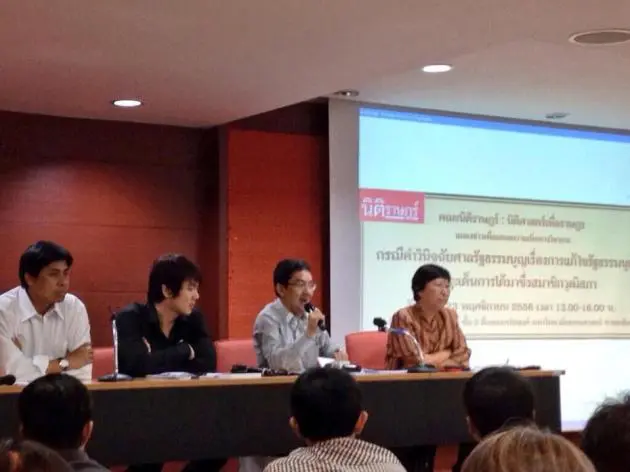


The Nitirat Group warned Saturday if the Constitutional Court's ruling on the charter amendment on senator selection is upheld, it could pave way for the world's first constitutional state.
Law lecturer Vorachet Pakeerat said at a press conference today said that the “unconstitutional ruling” sets the precedence that lawmakers can no longer amend the Constitution without the court’s approval.
“This will affect the democratic regime, which clearly separates the power of the legislative and the judicial branches. Whenever another attempt to amend the charter comes up again, the opposition could seek the court’s ruling… Eventually, the court would be the establishment that authorises the amendments,” he said.
The group announced that the court’s ruling is unconstitutional, because the court had no authority to rule on the case and the court also committed an unconstitutional process in doing so.
“The Article 68 was drawn up on German experience, allowing the government to seek the constitutional court’s endorsement to rip off the rights of a person, believed to commit an effort to change the regime. In the Thai case, those lawmakers are allowed by law to amend the charter. The court can’t just assume the power to tell what the lawmakers can do or can’t,” Vorachet said.
The Nitirat Group also said in Thai protocol, the Attorney General’s Office would use the power to seek the court’s approval. However, in this case, the court took into consideration the petitions filed directly to the court by politicians. Moreover, this ruling involved the authority of lawmakers.
The court also failed to find legal reasons to support its ruling that the charter amendment was unconstitutional.
Vorachet said that parliamentarians should seek a vote to ignore the court’s ruling, which is non-binding in nature as the court did not state penalties.
He warned that while the ruling is non-binding, it has been deployed by political groups to support their courses. If the situation continues, there will be no rule of laws in Thai society and “it would be difficult to cure or restore the situation in the future.”
