
Protest lodged with US


Play
ENVOY SUMMONED AND TOLD THAT OFFICIAL'S COMMENTS 'HURT' THAI SENTIMENTS AND WERE AN 'INTERFERENCE IN THAILAND'S INTERNAL AFFAIRS'
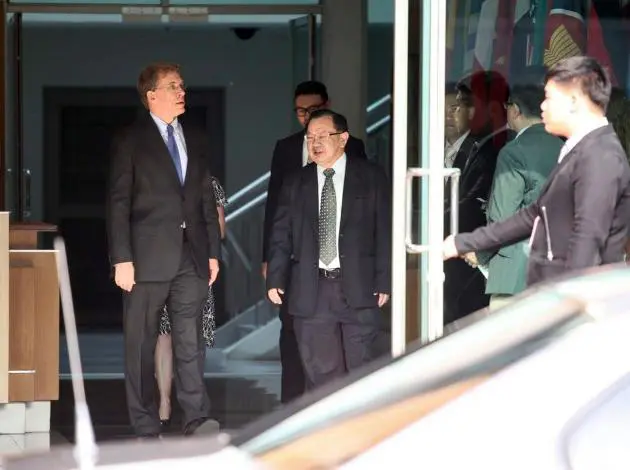
IN A MOVE seen as an attempt to protect what Prime Minister Prayut Chan-o-cha called “national dignity”, the Foreign Ministry yesterday summoned US charge d’affaires Patrick Murphy to express disappointment over the comments by a senior American official.
Murphy was also told that the comments were tantamount to an interference in Thailand’s internal affairs.
“As prime minister, I will not let any country interfere in our affairs. Every country has dignity. Thailand has dignity and we respect every country. I am sorry to hear opinions that do not reflect the truth. I am sorry that we have been friends for a long time. I am not the enemy,” Prayut said.
US Assistant Secretary of State for East Asian and Pacific Affairs Daniel Russel, who visited Thailand on Monday, had ruffled feathers when he called on the junta government to lift martial law and ensure inclusive reforms. He also remarked that the impeachment of former PM Yingluck Shinawatra was likely to be seen as driven by political motivation.
Deputy Foreign Minister Don Pramud-winai said after a meeting with Murphy that the statements made by Russel during his visit to Bangkok had hurt Thai sentiments.
Don said Murphy was “invited” to the meeting as Bangkok wanted to explain the facts of the political situation in Thailand.
However, observers |said the nature of the |meeting could be con-sidered as a protest as it took place early in the morning and just hours after the prime minister’s order.
Thammasat University academic Surachai Sirikrai said the summoning of an envoy is a normal diplomatic practice when the government has something to convey for better understanding. Countries usually use the diplomatic channel to communicate with each other when they need to explain or clarify anything, he said. China and Japan, when they are in conflict, also use this channel to communicate, he added. “In this case, Murphy would convey the message to the US State Department in Washington,” he said.
During his visit, Russel met former premiers Yingluck and Abhisit Vejjajiva as well as Foreign Minister Tanasak Patimapagorn to discuss the political situation.
But the statement that upset junta chief Prayut was the one Russel delivered at Chulalongkorn University.
Russel – the most senior US official to visit Thailand since the coup – said “the perception of fairness is important” while stressing the US was not taking sides in Thai politics.
“When an elected leader is deposed, impeached by the authorities that implemented the coup, and then targeted with criminal charges while basic democratic processes and institutions are interrupted, the international community is left with the impression that these steps could be politically driven,” he said.
Don told a press conference that Thais felt Russel’s statement and his visit hurt local sentiments and could even fuel the political conflict in Thailand.
“Instead of taking the opportunity to say something good, particularly promoting good bilateral relations, he [Russel] talked about domestic politics, which is not useful and tarnished Thailand’s image,” Don said.
“It is very disappointing and we regard it as interference in Thailand's domestic political affairs,” the deputy minister said.
“We assume that the US does not understand Thai politics, particularly when it talks about martial law, by saying that it wished Thailand lifted it,” he said. If the law were to be lifted, Don posed, who would take responsibility if something adverse happened?
While not ignoring the concerns of the US, he said the country is stepping towards democracy with dignity. The current situation in Thailand has no impact on US society or its economy. On the contrary, the US received better cooperation during the political chaos. “Maybe the US disagrees in principle only,” Don said.
Asked if there would be any negative consequences on bilateral relations as a fallout of the remarks, Prayut said ties between the two countries were still good. Bilateral trade is as normal. “We have been trying to reach out more to the US than we would do in normal political circumstances. However, representatives from the US and Europe have confidence in the government’s performance.”
Prayut urged the US to listen to both political camps and take into account differences in each country. “They may think of Western-style democracy but our lifestyle and our politicians are different,” he said.
The deputy foreign minister also informed the US side of the prime minister’s plan to attend the 70th United Nations General Assembly in New York in September this year and of the hope that the US would take this opportunity to reinforce bilateral ties.
