
Article 44 the best option: Wissanu


Play
GOVT INSISTS PM WILL USE PROVISIONS OF LAW ONLY FOR RECONCILIATION AND REFORM
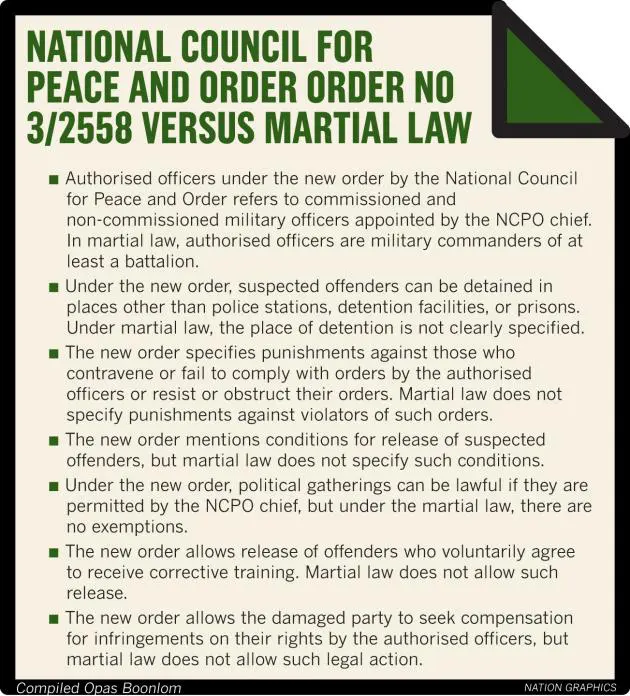
DEPUTY Prime Minister Wissanu Krea-ngam said yesterday the government saw Article 44 as the best option to replace martial law, as it would help maintain national security, boost the country’s image in the international community and restore business confidence.
Wissanu said an emergency decree would still show the country in poor light as people might feel Thailand was in an emergency situation, while the Internal Security Act could not tackle national-security issues.
He said the regime of the late Sarit Thanarat, another military leader who made himself prime minister after a coup, had resorted to Article 17 to suppress and tackle security issues.
“The Prayut [Chan-o-cha] government and the National Council for Peace and Order [NCPO] do not intend to use Article 44 in a violent manner, but we want to use the law for national reconciliation and reform,’’ he said.
Since martial law has been lifted, the three-court system will be restored – that is, the lower, middle and supreme military courts.
Cases that have been tried under military courts will adopt the three-court system, but cases that have already been ruled on will not be able to appeal against the verdict.
Details of Article 44 on media control are the same as stated in the emergency decree. “This is not intimidation of the media, as we would rather resort to talks like we have been doing with the media earlier,” he said.
PM’s Office Minister Suwapan Tanyuwattana said yesterday that the government needed to invoke Article 44 because intelligence and security agencies agree that there were still movements by those opposed to the highest institution, who threatened national security, were hiding war-grade weapons and violated the orders of the NCPO.
He said the article limited the scope of power that authorities can exercise and would stress prevention of violence and national division.
Under the law, political rallies and activities are allowed. “PM Prayut Chan-o-cha will use the law in a constructive manner for the benefit of the public,” he said.
He may take recourse to the law to crack down on pressing issues such as overpriced lotteries, exploitation of forest resources, illegal logging, expedite investment in government mega-projects, solve the country’s aviation problems identified by the International |Civil Aviation Organisation, |establish an anti-corruption mechanism and bridge disparity.
Army chief and Deputy Defence Minister Udomdej Sitabutr said that the public would benefit from the lifting martial law, as Article 44 aims to suppress perpetrators of violence and protect decent people.
He said people who had different ideas from the government and the NCPO would be negatively affected by the law if they want to harm others or disturb peace.
He said there was no sub-provision in Article 44, which could be seen as harsher than martial law.
After enforcing the law for some time, lawmakers will include details about levels of penalty such as jail sentences and fines.
People who face a jail sentence and fine can file a complaint seeking a review of the punishment with state agencies. “We give them the right to receive justice under international-standard practices,” he said.
He urged the media to help make foreigners understand in order to boost the country’s economy, especially tourism.
“There will not be violations of human rights by invoking this law but the law will better help the government protect human rights.”
Four types of cases will go to military courts – securities offences, war-grade weapons, violations of the junta’s orders and lese majeste offences.
Suspects are allowed to petition three courts – the lower, the central and the supreme military court.
