
New charter will pave way for weak, unstable governments: NRC


Play
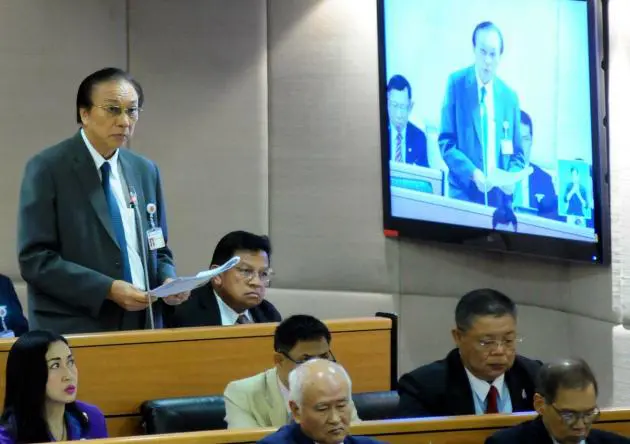
THE CHAIRMAN of the National Reform Council (NRC) panel on political reform, Sombat Thamrongthanyawong, yesterday called the kind of government that would eventually be formed from the new draft constitution "imbalanced", "weak", "unstable" and "di
He made these comments during the second day of a debate between members of the NRC and those of the Constitution Drafting Committee (CDC), who were taking part to present their newly drafted charter and the underlying reasons and ideas behind it.
The second day of the debate touched on some of the most controversial topics in the draft charter, concerning the political system, political parties and politicians. Many believe the new provisions that had been inserted into section two of the draft can play a pivotal role in solving the country’s problems and enable it to move on from a decade-long political crisis.
Sombat, who has been outspoken in his disapproval of the CDC’s proposals on political reform right from the outset – that is, since the end of last year – laid out various risks that such provisions could lead to.
He paid special attention to the fact that governments would be derived from the mixed-member proportional (MMP) system, new provisions that further strengthen the checks and balances on power, and the clause allowing an unelected prime minister.
Articles 172 and 173 of the new draft constitution allow a non-elected candidate to become PM through a parliamentary vote, thus making the government’s head “disconnected” from the people, said Sombat.
“The notion that an ‘outsider’ should be allowed to become prime minister means that he or she has no direct connection to the people at all,” he added.
He also said the government derived from this draft charter would be “weak and unstable” because of the newly introduced MMP system.
Coalition government means there will be a lot of back-room wheeling and dealing among coalition parties for their own benefits, hence the collective national goals would become secondary in importance – and as a result, the government may struggle to lead the country forward, he warned. On the other hand, if the wheeling and dealing between coalition parties broke down, it would lead to the dissolution of Parliament, or result in a “lame duck” administration, he said.
Moreover, the power relationship between the executive and legislative branches would become “imbalanced” under the new charter because of Article 182, since the executive branch would be given too much power, said Sombat.
Article 182 is designed to provide an executive branch derived from a coalition government with power over the legislative branch, so they can be decisive and push through important bills for their administration.
The PM can, under the new draft charter, declare what he or she perceives as an important bill that needs to be passed by the House of Representatives, and if the House does not submit a no-confidence motion within 48 hours, the bill will be passed.
“Imagine, if the PM is proposing another amnesty bill, this means that the people may not agree with such a bill, but they can do nothing about it. This may bring the protesters back on the streets … It is enough to create another crisis,” he claimed. On this point, Sombat was supported by another prominent member of the NRC, Seree Suwanphanont, who is chairman of the council’s committee on legal and justice reform. Seree also disagreed with proposed measures that would lead to coalition government, such as the MMP system.
