
Turn crisis into opportunity: PM


Play
AGENCIES TO ALLOCATE ZONES FOR SUITABLE PLANTS, WHILE MORE WELLS TO BE DUG
PRIME MINISTER Prayut Chan-o-cha yesterday instructed agencies to “turn a [drought] crisis into an opportunity” by allocating zones to grow suitable plants, while also ordering 1,000 wells to be dug.
During the Cabinet’s mobile meeting in Chiang Mai, Prayut said he had ordered that the nation irrigation coverage be increased 10 per cent by 2016.
As only 40 per cent of the country’s 137 million rai of agricultural land was covered by the irrigation system, areas outside the zone would need additional action, he said, suggesting agricultural-land zoning to ensure less water-dependent crops were grown in suitable areas.
He said the domestic usage of water, export and demand for agricultural products, as well as promotion of product processing, should also be addressed.
As some 2,000 artificial-rainmaking operations have reportedly not yielded enough rain because of insufficient cloud and dry weather, Prayut called for budget adjustment in drought-tackling measures, including the digging of 1,000 wells – double the original plan.
Meanwhile, His Majesty has granted personal funds to aid rainmaking operations and urged the setting up of two special rainmaking centres were set up in Nakhon Sawan and Chiang Mai provinces, Jor Sor 100 FM radio station said yesterday.
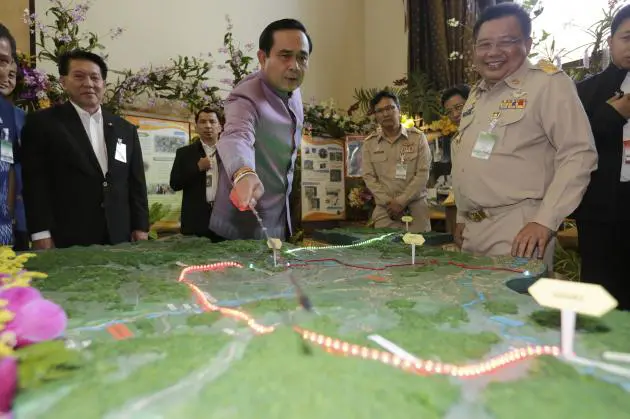
Before the Cabinet’s mobile meeting, Prayut visited agencies’ booths in the venue and helped correct some display boards with markers, as he said they needed to provide more information and better presentation.
Listening to Royal Irrigation Department chief Lertwiroj Gowat-tana’s presentation on the water-management model, Prayut reportedly pulled the official’s hand from the model to stop him, and then asked questions about water sources and why waterways had dried up. He then urged officials to find places to retain rainwater, and to dredge waterways.
Jor Sor 100 FM radio quoted Royal Rainmaking and Agricultural Aviation Department chief Warawut Khantiyanont’s remarks about HM’s assistance for rainmaking operations. He said the new Nakhon Sawan centre would oversee operations in the Chao Phraya River basin, while the Chiang Mai centre would cover operations in the North.
Warawut said the department’s 11 rainmaking-operations centres nationwide, which have 20 aircraft, had since March 2 carried out some 2,150 sorties, resulting in rainfall in 66 provinces.
The department was also being helped by the Royal Thai Air Force in setting up a further three centres with 10 planes to help make artificial rain, he added.
A number of areas have started to carry out rainmaking operations, particularly upstream of dams.
Northeastern Region Royal Rainmaking Centre chief Thawee Kanchana said his office’s seven aircraft had conducted six daily sorties to sprinkle 20 tonnes of chemicals, half of which was used in Nakhon Ratchasima to refill the Lamtakhong reservoir. Similar operations were carried out in Prachuap Khiri Khan, Phetchaburi and Ratchaburi provinces to refill the Pran Buri and Kaeng Krachan dams.
Meanwhile, in Rayong’s Muang district, villagers in six communities of tambon Noen Phra yesterday urged the Map Ta Phut Industrial Estate’s 10-year-old water-pump station immediately to stop taking water from Klong Namhu, as water had become scarce for farmers.
Muang Rayong clerk Tachapol Eium-ngam said he would ask the estate to stop pumping water for now, after which a joint panel would be established to formulate a new agreement to ensure fair water management.
