
Liquor and cigarette companies suspected of attack on 'sin tax' revenue


Play
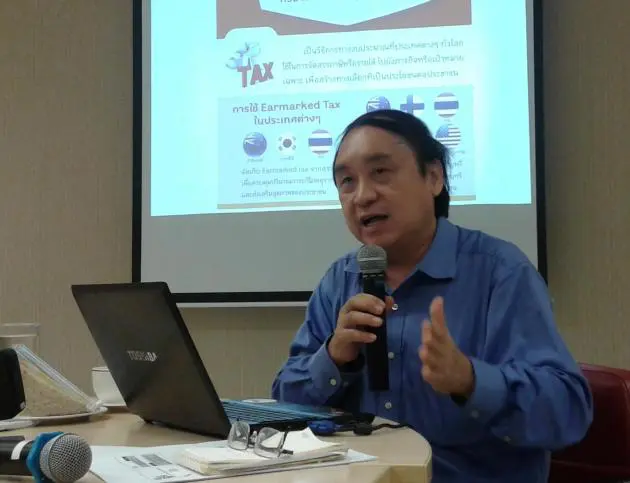
THE Health Promotion Foundation has voiced suspicion that some liquor and cigarette firms are behind efforts to ban the use of an earmarked tax.
An earmarked tax is a tax whose revenues are, by law, reserved solely for a specific use or group; for example, the health of the community.
Since its establishment in 2001, the foundation has earned income from the collection of earmarked tax in an amount equivalent to two per cent of revenue from so-called “sin taxes”.
The foundation has used the money to promote the health of Thais via various measures including campaigns against smoking and alcohol consumption.
“I think the firms affected by the foundation’s work have lobbied political-office holders into banning the earmarked tax,” foundation’s deputy CEO Dr Supreda Adulyanon said during an exclusive interview with Nation Multimedia Group.
He was referring to Article 190 of the charter draft, which seeks to ban the earmarked tax. According to this article, the current recipient of the draft shall enjoy the earmarked tax for no more than four years after the new Constitution takes effect.
Supreda said some people had supported the ban of an earmarked tax only because they misunderstood that the foundation took away two per cent of what should go to the state coffers.
“But the truth is that the country still gets 100 per cent of the taxes imposed on sold liquor and cigarettes. It’s just that an additional two per cent in sin taxes are imposed on these products to raise funds for the foundation,” Supreda explained.
He said if the earmarked tax for his foundation ended, liquor and cigarette businesses would benefit.
Critics, so far, have said that the foundation earned about Bt4 billion a year – but its budget use is not subject to clear scrutiny, unlike what happens to state agencies.
To get a budget from the government, state agencies usually have to plan at least two years ahead as their budget plan will be a part of the annual budget act. The government presents an annual budget to Parliament or the National Legislative Assembly to deliberate before it can become a law.
Supreda said budget use by the foundation was scrutinised by the foundation’s board, the foundation’s performance evaluation committee and the Office of the Auditor General.
“We have also reported our budget to the Cabinet, the Parliament and the Senate.” He said the remaining portion of the budget each year was added to a revolving fund, which is invested in low-risk investments to generate money to be used in emergencies.
He said clear measures were also in effect to select and approve projects that receive funds from the foundation.
“For example, if a project requires over Bt20 million budget, it needs to be checked by seven specialists before another committee approves it.”
‘Streamlined process’
He said the foundation enjoyed a more streamlined process compared to state agencies. And this streamlined approach allowed the foundation to avoid bureaucratic red tape.
When asked why the foundation did not call for bids, Supreda said the foundation had made fund-approving decisions based on performance.
“If a credible partner comes forward, why shouldn’t we support its project? This partner, after all, has delivered impressive performance before,” he said. At present, the foundation has had more than 10,000 partners, both new and old.
Supreda said the foundation could continue to operate if the government deprived it of the earmarked tax. He complained that the normal budgeting could pave the way for political intervention, which might arise out of lobbying by liquor or cigarette firms.
Statistics show that 25 per cent of Thais aged at least 15 years old were smokers in 2001 – the year the foundation first started its operation. But in 2012, the percentage dropped to just 19.94 per cent.
Supreda said the foundation’s income rose because liquor and cigarette prices had also increased. By comparison, ThaiPBS, the broadcaster that gets an earmarked tax, is required to receive no more than Bt2 billion a year.
“There should not be any cap. Otherwise, the budget for health promotion would in effect be shrinking. We need to take the inflation rate into account,” he said.
