
Case on rice-subsidy scheme starts badly for Yingluck


Play
Court rejects two petitions; concern over mass of files from prosecutions
FORMER PM Yingluck Shinawatra suffered a setback yesterday when the Supreme Court rejected two petitions by her lawyers at the first hearing on the rice-subsidy scheme, and her legal team expressed concern that it might not have time in the next two months to study a mass of documents submitted by prosecutors.
Yingluck has been charged with negligence in her oversight of the scheme, which cost the country at least Bt500 billion, and she could face up to 10 years in jail if found guilty of dereliction of duty.
The former premier appeared at the court and asked that it suspend the trial on the grounds that the rice-pledging scheme case must be tried by the Administrative Court not the Supreme Court’s Criminal Division for Political Office Holders.
She also opposed the prosecutors’ move to question an additional 23 witnesses.
Supreme Court deputy president Veerapol Tungsuwan, the presiding judge, led eight other judges to examine evidence for the case, in which Attorney General Trakul Winitnaiyapak accused Yingluck of violating Article 157 of the Criminal Code and the National Anti-Corruption Act for refusing to abandon the scheme when huge rice stockpiles and debt piled up.
The judges ruled against Yingluck’s request to transfer the case to the Administrative Court on the grounds that the plaintiff accused the defendants on criminal charges and the Administrative Court does not have authority to hear criminal cases.

The court also rejected Yingluck’s petition against the prosecutors adding 23 witnesses and submitting additional documents as evidence. She claimed the move was illegitimate and unfair since she and her legal team had not seen them beforehand.
The judges ruled against her request, reasoning that although the court has to follow the writ filed by the National Anti-Corruption Commission it also has the right to seek the truth by summoning more witness and evidence. The defendants have the right to counter the plaintiff’s evidence, they said.
Prosecutors have submitted 160 files with 60,000 pages of documents, while Yingluck’s lawyers presented 61 files. So, the court ordered that both sides review the evidence every Wednesday and scheduled October 29 to examine witnesses.
Before the trial, Yingluck said she was confident that she has a solid case, with 71 witnesses to defend her. They were people who gave statements to the NACC, although the graft agency had refused to listen to some of them.
She was ready to fight all the charges against her and would appear at the court for all the hearings, she said.
However, her lawyer Norawit Lalaeng said the legal team was worried about the large number of new documents submitted by prosecutors, as they had not seen them yet.
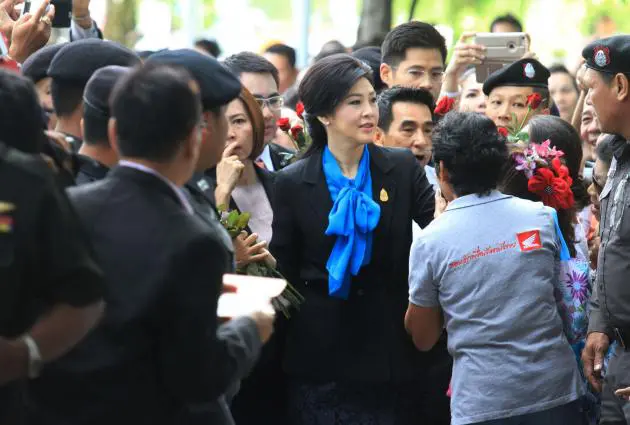
Yingluck arrived at the court with a big smile for her supporters, who greeted her with applause and handed her red roses. Her supporters included former ministers, former Pheu Thai MPs and red shirt leaders.
The rice-pledging scheme was Yingluck’s flagship election policy and helped sweep her to office in a landslide in July, 2011. However, it wracked up massive losses amid claims of widespread graft. Its failure saw her banned from politics for five years in January by a legislature appointed by the generals who toppled her government in May last year.
