
Aung San Suu Kyi steps in on copper mine conflict


Play
Yangon - Myanmar democracy icon Aung San Suu Kyi vowed Thursday to help negotiate a peaceful solution to a conflict between villagers and authorities over a Chinese-run copper mine that has left up to 50 people injured.
Police early Thursday used water cannon, tear gas and smoke bombs to disperse a demonstration outside the Latpadantaung copper mine in north-western Myanmar, injuring at least 50 people, including Buddhist monks, according to protesters and government sources.
The use of force was reminiscent of the days of military rule, but President Thein Sein insisted it was for the sake of rule of law.
"We did it for rule of law, to protect of benefits of the country and people in accordance with democratic practice," the president'soffice said in a statement.
Most of the injured suffered burns. One monk had to be driven to Mandalay for an emergency operation, protesters said.
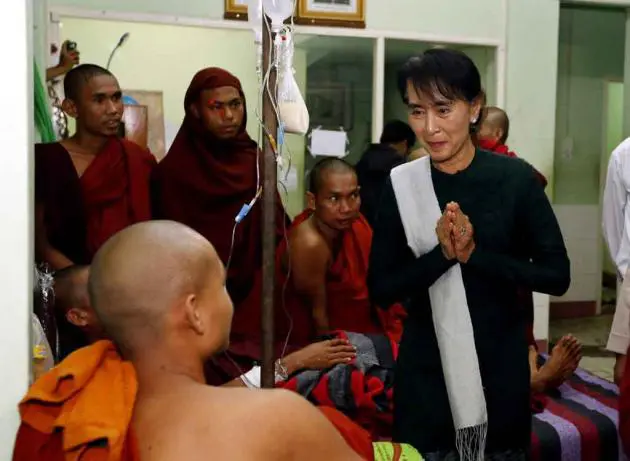
Opposition leader Suu Kyi travelled by car to Monywa, 827 kilometres north-west of the country's largest city Yangon, where she visited victims at a hospital and later talked to villagers.
"I will negotiate peacefully and successful for both sides," shesaid, adding, "Do you all agree with my negotiations?" The people answered, "We agree." Suu Kyi, who spent 15 years under house arrest between 1989 to2010, is now a member of parliament, heading a commission on rule of law issues.
More than 200 protesters had refused a government order to leavethe camp outside the mine in Sagaing division after most of the demonstrators had evacuated. An initial deadline of midnight (1730GMT) Wednesday was extended to Thursday.
"They counted down five minutes, and then the police used waterhoses, tear gas and firebombs on us," protester Myo Thant said by telephone.
The demonstrators fled and re-gathered at a nearby site, protesters said.
The mine, a joint venture between the Myanmar military-owned Economic Holdings Ltd and China's Wanbao Co Yang Tze Copper Ltd, has resulted in illegal confiscation of land from villagers and pollution, protesters said.
Parliament on Wednesday set up an independent commission to investigate the pollution claims, but legislators said the mine must first resume operations so it could be assessed. A similar protest at the mine in September resulted in mass arrests.
The joint venture was awarded its concession in March 2010 when Myanmar was still under military rule. Such protests were rare under the junta that ruled from 1988 to2010 and were quickly and violently repressed.
A widespread pro-democracy movement in 1988 was crushed by an army crackdown that left up to 3,000 people dead. In 2007, the junta unleashed its troops on a protest in Yangon that was led by Buddhist monks.
The current government, chosen in November 2011 in Myanmar's first elections in 20 years, has carried out political and economic reforms and tolerated public expression of political views although the Latpadantaung copper mine incident might taint its reform image.
Thein Sein last year shelved a 3.5-billion-dollar Myitsone hydropower plant in the northern state of Kachin after the Chinese project ran into stiff opposition from villages and environmentalists, who said the project would adversely impact the Irrawaddy River.
