
Reforestation scheme to combat illegal logging


Play
Amid reports of illegal logging and deforestation, the Ministry of Environmental Conservation and Forestry recently announced the reforestation scheme to cover 2.2 million acres by 2030.
As the sub-committee on farming, livestock and forestry revealed that it reforested 118,680 acres of land between 1995 and 2014 including 10,300 acres that accommodate teak trees, Aye Myint Mauk, deputy minister for environmental conservation and forestry, said during a parliamentary session that Myanmar is suffering from critical forest depletion.
In 2006, Myanmar allowed private companies to grow hardwood trees. In six years, they planted 107,453 acres of teak and 46,180 acres of hardwood, according to the ministry.
Yet, annual deforestation in Myanmar amounts to 900,000 acres a year and the country is ranked eighth in the top ten most deforested countries in the world.
Logging in Myanmar exploded under the former junta, as the generals tossed aside sustainable forestry practices in their thirst to cash in on vast natural resources.
Experts say an insatiable world appetite for precious hardwoods is threatening rare species and helping to drive deforestation in one of the last major areas of tropical forest in Asia.
The country lost almost 20 per cent of its forest cover between 1990 and 2010, according to the UN Food and Agriculture Organisation.
Widespread degradation of the most densely wooded areas means that so-called “closed forest” more than halved in size, from 30.9 million to 13.4 million hectares.
Experts say corruption and poor protection have enabled rampant illegal logging that lines the pockets of crony businessmen, soldiers and rebels groups alike.
A quasi-civilian government that replaced outright military rule in 2011 has sought to stem the flood of timber from the country with a ban on the export of raw logs which took effect on April 1.
“Our ban will be very effective. There will be cutting, distribution and finishing of timber products locally, so that we can also increase employment opportunities,” said the director general of the Ministry of Environmental Conservation and Forestry, Tin Tun.
Wildlife group WWF said the biggest driver of forest loss has been large-scale conversion for agriculture, often after woodland is degraded by logging or the collection of wood for fuel.
It welcomed the export ban and said the government has also slashed quotas for teak and other hardwoods by 60 per cent and 50 per cent respectively for the coming fiscal year compared to 2012/13.
“But given the high volume of illegal logging and exports in Myanmar, it will take a long time before we see how effective the ban will be,” said WWF’s Myanmar conservation programme manager Michelle Owen.
Frank Momberg of conservation group Flora and Fauna International, is struggling to protect the newly discovered and critically endangered Myanmar snub nosed monkey. There are thought to be barely 300 of the flat-faced primates left in the dense forests of Kachin state at the eastern tip of the Himalayas.
“A complete ecosystem is being destroyed by this radical logging,” Momberg said.
China recorded importing 10 million cubic metres of round logs from its impoverished neighbour between 2000 and 2013 - almost twice Myanmar’s officially registered global export trade of 6.4 million cubic metres for the period, according to the Environmental Investigation Agency (EIA) campaign group.
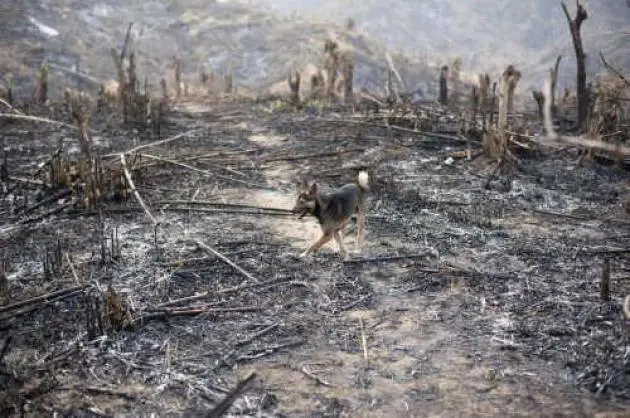
Ashen earth strewn with the limbs of once-mighty trees is all that is left of the fearsome forest in central Myanmar.
“We would only dare enter in a big group. The forest was deep and had many wild animals. Now we cannot even find a tree’s shadow to shelter under when we are tired,” Wa Tote, 72, told AFP.
“It’s like an extinction frontier,” noted Tony Neil, forest governance advisor at Myanmar environmental group EcoDev.
