
Roadmap to listing starts with IPO test run, experts say


Play
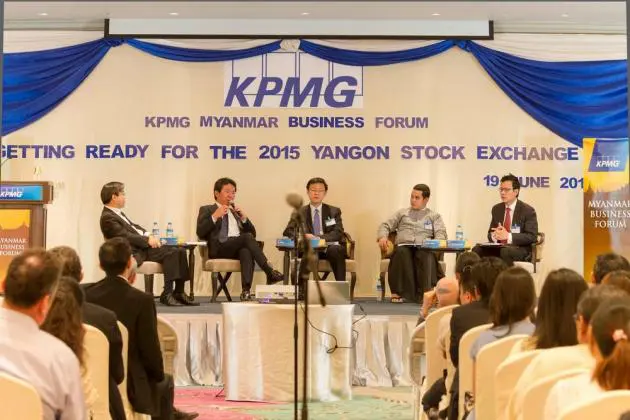
Myanmar needs to encourage more companies to be listed in the upcoming Yangon Stock Exchange in order to achieve its capital market goal, experts said at the KPMG's Myanmar Business Forum held in Yangon on Thursday.
“A stock exchange is meaningless without listed companies. The capital market needs securities companies, and very educated investors. So we are now focusing on initial public offerings (IPOs),” said Shinsuke Goto, a director of Daiwa Securities Group, which has been mainly helping to establish YSE.
Goto added that Daiwa is currently focusing on doing IPOs, a process it initiated last year. At first, it is expected that leading, big companies will be listed in the YSE. But later, the stock exchange needs to invite smaller companies, he said.
Yasuhide Fujii, managing partner of KPMG in Myanmar, echoed Goto’s view.
“For the success of the capital market, I think we should have good quality listed companies. When we came to Myanmar two years ago, comparing it to other emerging countries in Indochina, we saw that Myanmar’s economy is driven by private companies, not state-owned companies. How to attract all these companies to be listed is a key issue,” said Fujii.
According to KPMG, companies that undergo pre-IPO testing and preparation will be in the best position to maximise the value of their business, raise the bar of transparency in doing business and complement the pace of economic growth in Myanmar through a vibrant and credible stock market.
“Myanmar companies considering a listing on the exchange should first ask if an IPO is the right choice and at the right time given their stage of development and prospects. Running a comprehensive pre-IPO test can help companies evaluate both timing and readiness for a listing,” said Fujii.
He added that robust preparation, ongoing governance and transparency will not only increase the number of good securities on the exchange, but will accelerate international investor appetite in the local capital market. To him, an optimal operating structure combined with sound corporate governance and transparency will enhance shareholder value, mitigate risk and ultimately provide investors with confidence in the YSE.
Tanate Kasemsarn, KPMG partner in Thailand, said that businesses should develop an IPO roadmap and test to ensure IPO readiness and adequate preparation.
“First of all, a company needs to set its destination. Then, it should formulate its equity growth story. After that, a pre-IPO readiness test needed to be conducted,” said Tanate, adding that such test is vital to find out which group structure, accounting standards, systems, processes, and internal controls need to be changed.
Tanate urged to develop a proper business plan and prepare financial and related requirements to meet the criteria of both stock exchange and investors after conducting the pre-IPO readiness test.
