
US prefers to 'partner, not compete' with China
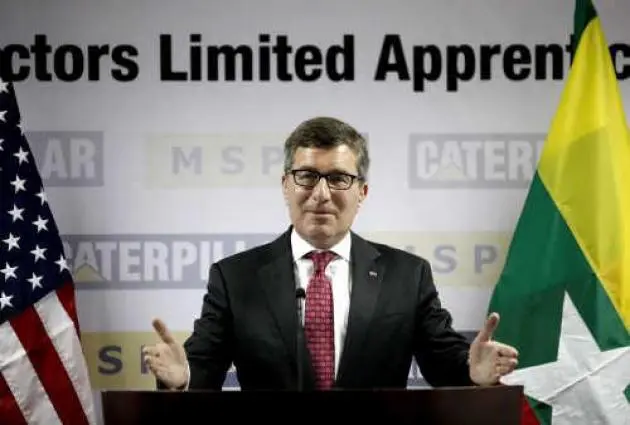


The United States prefers working in partnership with China rather than competing with the country in the Myanmar market, a high-ranking US government official said today.
The US has no interest in competing with the world’s second-largest economy in the newly opened Myanmar market, Charles Rivkin, assistant secretary of state for economics and business affairs, told a press conference. The press conference was held at the factory of Myan Shwe Pyi-Caterpillar Tractors Ltd in Thaketa Industrial Zone.
After stating that the US is interested in establishing economic dialogue with China, he added: “American companies can compete with any firms in the world anytime and in any place.”
Besides being upbeat on the competitiveness of American firms, Rivkin expressed optimism about Myanmar’s economic future. “In the Asean-US Business Summit [held this week], I met with all the biggest American companies. Many of them are interested in doing business in this country. The future is bright. They see many opportunities here. And I see that it is progressing in the right direction,” Rivkin said.
Since the US begin easing sanctions on Myanmar in 2012, US firms have invested well over US$1 billion in the country. “Since 2012, GE, Gap, Coca Cola, Pepsi Co, etc, already committed to invest more than US$ 612 million. Today, we have received another commitment from an American energy company to invest US$ 480 million in this country,” said Rivkin.
“Only in two years’ time, the United States has eased around 80 per cent of the sanctions. Two years ago, American companies couldn’t invest in Myanmar. A lot has been done [since then] and only specifically-targeted sanctions remain,” he said, referring to the US Treasury Departments Specially Designated Nationals and Blocked Persons. It is illegal for American companies to conduct business with any individual or company on the so-called SDN list unless they obtain a licence to do so from the Treasury Department.
During the press conference, the official also appreciated the corporate social responsibility programmes of US businesses in Myanmar, including those of Caterpillar, one of the world's largest manufacturers of construction and mining equipment, diesel and natural gas engines, industrial gas turbines and diesel-electric locomotives.
“Caterpillar is providing education opportunities to the youth of Myanmar. Not only is Caterpillar helping to build Myanmar’s future, but it is also trying to strengthen its presence in this country. Caterpillar is one example of American brands that bring only the highest standards of business ethics and professionalism to the people of Myanmar,” Rivkin said.
“Beyond corporate social responsibility is trade, education, and capacity-building because the future of the country is very bright. For too many years, opportunities and prosperity laid in the hands of a few. Now the country has a promising new generation,” he added.
The assistant secretary also reiterated the Washington’s commitment to bring the highest standards of investment to Myanmar, not just in Yangon but the rest of Myanmar as well.
“It is very impressive to see 50 per cent of these trainees [taking Caterpillar’s training courses] come from Yangon and the others are from all over Myanmar,” Rivkin said.
He said the 2015 elections would not affect the US businesses’ interest in stepping into the nation’s rapidly expanding market.
“I don’t think the willingness of investors particularly depends on anything except the bright future of this Asean region and that of the country. But we are also watching the election very, very closely [to see] whether it is transparent and fair,” Rivkin said.
During his four-day visit to Myanmar, he traveled to Nay Pyi Taw on August 27-29 to participate in the US-Asean Business Summit. There, he met with Asean Business Council and US Chamber of Commerce representatives to discuss issues of mutual economic benefit to Asean countries and the US.
In Yangon, on Friday, he visited a facility run by Caterpillar that trains youths to highlight American companies’ commitment to corporate social responsibility. While in Yangon for two days (August 29-30), the Assistant Secretary has scheduled to speak with business leaders on innovation and meet with women entrepreneurs. After leaving Myanmar, Rivkin will visit Singapore, Hong Kong and Beijing
