
Telecom operators optimistic as competition heats up


Play
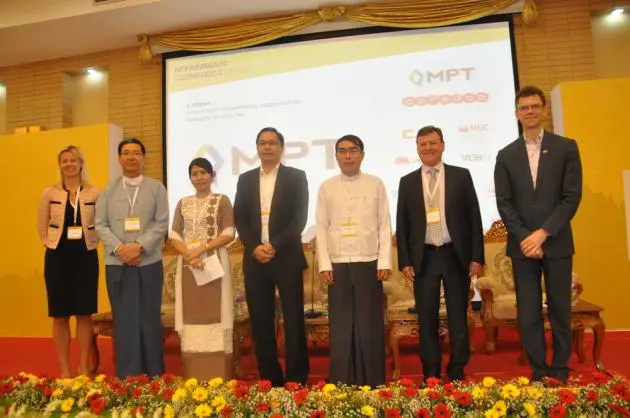
Top executives from the four network operators identify hurdles but focus on solutions as they seek their share of a market set to boom
Nay Pyi Taw - All four telecom operators yesterday expressed optimism for their business prospects, despite the many challenges they face to operate networks in the country.
Excellent service is key to attracting customers, senior executives from the four operators told the Myanmar Connect 2014 forum in Nay Pyi Taw on September 16 and 17.
Senior executives from Myanma Posts and Telecommunications (MPT) said it would surprise the market with upcoming incentives and services. MPT had a monopoly until last month, allowing it to acquire many customers.
“We have a plenty of quality personnel and excellent techniques. We know very well that there is very intense competition as all the operators are well experienced. But MPT has been transformed to provide better services. Just wait and see how we will play this game,” said Khin Maung Tun, deputy chief executive officer of MPT-KDDI-Sumitomo joint operations.
MPT has planned to sell more than 14 million SIM cards by 2015.Last year, it sold more than 4 million, and plans to sell more than 5 million this year and the same amount next year.
“Our top priority is to make service more accessible and more affordable for more people in Myanmar. That is why we introduced new SIM cards for Ks 1,500 [about US$1.5]. We have distributed thousands of SIMs this year. We are pushing for more than 5 million SIM cards into the market by the end of the year so that people will get them more easily at the right price,” said Khin Maung Tun. The executive declined, however, to say how many Ks 1,500 SIM cards had been sold so far, or provide details of the new incentives and services it planned to introduce, saying this was confidential.
Despite the increasing sales of SIMs, MPT is currently struggling to meet market demand as some mobile shops are selling MPT SIMs for Ks 10,000 or more. Khin Maung Tun said MPT was trying to solve the problem as soon as possible, and urged people not to buy SIM cards on the black market.
“We will be providing sufficient amounts to stop the black market trade. We know the demand perfectly well. Yet, we need to take QoS [quality of service] into serious consideration before we sell our SIM cards,” Khin Maung Tun told Myanmar Eleven on the sidelines of the conference.
“If we focus too much on the quantity of the SIM cards, it may lead to some difficulties in the service. On the other hand, we urgently need to establish base transceiver stations, and we should also focus on increasing our network coverage. We need to take some measures to balance demand and supply,” he said, adding that selling all the SIM cards at one stroke may lead to technical problems in the network.
Japan’s KDDI and Sumitomo have committed to invest up to US$ 2 billion in MPT’s operations. The MPT executive said that cooperation with the two Japanese corporations is a model of public-private partnership, as well as a strategic attempt by MPT to maintain its position as the top operator.
MPT may reduce the price of calls, according to a KDDI executive.
Koichi Kawase, general manager of KDDI Summit Global Myanmar Co Ltd, told the conference that pricing moves were an ongoing process to maintain MPT’s current customers and attract new ones.
“We are thinking about all the possibilities and how to satisfy our customers, including data-connection issues. We have to consider … reducing dialing fees, and study how it will affect the customers’ interest and the industry as well. And we are seeking formal appropriate timing to introduce the new prices. Once we are ready, we will announce it,” Kawase said.
Another local operator, Yadanarpon Teleport Public Co Ltd, is also optimistic about winning the market despite its late entry.
“We will try our best to win the late comer’s opportunities. We can learn from other operators’ mistakes and can prepare to satisfy every customer using our service,” said Nilar Aye, Yadanarpon Teleport’s head of business development and corporate affairs department.
Yadanarpon Teleport, a former state-owned enterprise that was recently corporatised as a public company, is also facing challenges.
“We also have a lot of challenges and many difficulties. We are discussing business plans and rollout. We need to consider not only for the population coverage but also for the geographic coverage because our people are mostly in the rural area. It is very challenging to discuss with the partners to get agreement on such matters,” said Nilar Aye.
“We are facing not only technical-related but also some internal challenges as well. We are also nurturing and maintaining our human resources. This is the transition stage. We are trying to maintain our people as well. It is very challenging and very interesting,” she added.
Ooredoo, the earliest foreign player in the industry, said that it also faced plenty of difficulties in its rapid entry to the blooming market, including distribution of SIMs in townships, states, and regions across the country. But its top executive said the firm has overcome most challenges with the “fantastic support” of the Ministry of Information Technology and Telecommunication.
“Now the process is running pretty well,” said Ross Cormack, chief executive officer of Ooredoo Myanmar.
Like other international players, Ooredoo also faced a shortage of skilled labour. Yet, Cormack said that the firm tried to solve the problem by providing training for local people.
“Myanmar people have a very bright future. We have trained 3,500 people in customer service and distribution, and will train more people in the future because youths are the future of any company,” Cormack said.
Currently, Ooredoo SIM cards can be used only with 3G handsets, which are usually more expensive than 2G handsets. The latter can be used with MPT and Telenor SIM cards. This may make price-sensitive consumers opt for MPT or Telenor, as handsets for Ooredoo’s service may be out of their range.
Cormack said that he Qatari-based operator will try to solve the problem by selling low-cost handsets.
“When we go around the country, particularly to rural areas, people normally do not have as much income as in big cities where we launched. So we know it is essential, and we will be able to sell them very soon,” he said.
“We will be ready to tell you something about that in the next few weeks. It is very important,” he added.
During the conference, Petter Furberg, chief executive officer of Telenor Myanmar, also shared some of the difficulties the Norwegian titan has faced here.
“The expectations [of consumers] for both Ooredoo and Telenor are very, very high. Physically, it is very difficult to meet their expectations. which are really related to coverage. I think to meet their expectations is the biggest challenge we are facing,” Furberg said.
“We are lucky to work in this country to be part of work to create history. As Ross [Ooredoo CEO] said it is one of the biggest challenges to recruit good, talented people,” Furberg said, adding that such difficulties may be overcome in two years thanks to capacity-building programmes.
The company's country head said that establishing a new business in Myanmar was extremely exciting. Coverage mapping and rollout are also challenging, he said.
When asked about the exact date for the launch of its SIM cards, Furberg was coy.
“I am sticking to a very consistent story today. It is ‘soon’,” he said.
