
More loans for distressed farmers


Play
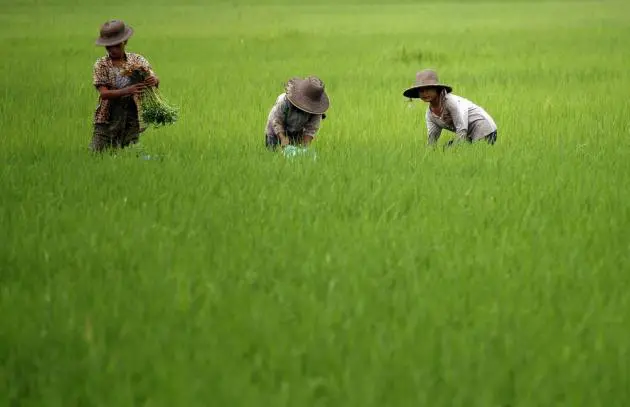
The Ministry of Cooperatives is borrowing a total of US$300 million from China for relending to farmers in 2015, said Kyaw Hsan, head of the ministry.
He said that the loan from China would allow the ministry to raise the maximum loan to each farmer from $100 to $500.
“The amount we are now lending to farmers will be increased from $100 to $500 because $100 is not enough for them,” he said.
“Since the Cooperative Ministry’s fund is not large enough, the $300 million loan will be borrowed from China with the support of the president. China has already agreed to it. It will be submitted to parliament ... and I believe the parliament will approve it remembering the slogan: ‘The parliament accomplishes the public’s expectation’,” said the union minister on November 7.
Out of eight million rural families in Myanmar, according to the current census, only two million deal with the Cooperative Small Loan Enterprise and the aim was to include the remaining six million, said the union minister.
“As China asks for a low interest rate, we can pass that on to the farmers. We can borrow by mortgaging Cooperatives Ministry land and buildings to lend back to the farmers. The Ministry of Cooperatives has had a bad reputation for consecutive years. We are now following new rules, organisation and regulations,” he added.
The Ministry of Cooperatives has lent more than US$197 million to two million farmers in more than 22,000 villages.
Aside from land grabbing, falling agricultural prices become a major problem for farmers in Myanmar.
On November 7, the Myanmar Farmers Development Party celebrated its 2nd anniversary with an open request for the government’s help.
Kyaw Swar Soe, chairman of the party, said that the government needs to deal with farmers’ losses caused by falling prices and pressures to repay agricultural loans every harvest season.
The paddy price per basket has decreased to Ks 2,800-3,000 from about Ks 4000, he said, and current heavy rain had also damaged paddy plantations at harvest time.
The Myanmar Agricultural Development Bank under the Ministry of Agriculture and Irrigation has been disbursing loans to farmers. For this monsoon season, the bank granted about Ks 1,000 billion in loans to farmers with a 5 per cent interest rate.
“It is common in the harvest season. The bank puts pressures on farmers for the repayment of agricultural loans. And then the bank files a lawsuit against them if farmers fail to repay the loans. This causes farmers to sell their paddy to the rice associations at a low price. Such events seem to go together. The government needs to give cover to deal with this problem,” Kyaw Swar Soe added.
During a tour to the US, officials from the Farmers Development Party explained the situation farmers face. Cooperation between farmers and the US government can increase US growth but the current situation in Myanmar goes against US interests, he claimed.
Kyaw Swar Soe said the arrest and sentencing of farmers, was unlawful and the government’s repressive laws amounted to bullying.
Currently, Myanmar farmers’ associations are planning to buy monsoon paddies to cover the losses caused by plummeting paddy prices.
--
NLD denies "any connection" with US blacklisting of Aung Thaung
Myanmar Eleven
The National League for Democracy has nothing to do with the US blacklisting of Aung Thaung, and the party will continue its efforts on national reconciliation, said NLD chairperson Aung San Suu Kyi to reporters on November 10 in Nay Pyi Taw.
“We only heard about [the blacklisting] after (the US) did it. They had never discussed doing it with us. We're now working toward national reconciliation and not interested in backsliding acts. It's no good for anyone,” said Suu Kyi.
“NLD has no connection with the blacklisting. We didn’t know about it before it was announced. We have no intention to take revenge. National reconciliation is more important. It is the only thing that will benefit the whole country. Taking revenge will never do so. That's my vision. I say it over and over again. We never change our mind,” said Suu Kyi, responding to a question raised by the reporters about whether the NLD had any involvement in the blacklisting.
When asked whether he believes his blacklisting was coordinated with opposition parties, MP Aung Thaung responded, "I have no idea. It might be so. But I don’t think any opposition parties could do this.”
The MP said his blacklisting may be an act aimed to weaken the ruling USDP party, for which he works as an advisor.
Aung Thaung, chairman of Lower House’s MPs and Banks and Financial Development Committee and former minister for Industry-1, was blacklisted by the United States on October 31. He is also the father of Nay Aung, the largest shareholder of United Amara Bank (UAB). The blacklisting spurred mass withdrawals from the bank, prompting the Central Bank of Myanmar's intervention.
The US Treasury Department said Aung Thaung has been involved in attacks on the democratic opposition.
"By intentionally undermining the positive political and economic transition in Burma, Aung Thaung is perpetuating violence, oppression, and corruption," Adam Szubin, the Director of Treasury's Office of Foreign Assets Control, said in a statement.
The action freezes any assets Aung Thaung has in the United States, and prohibits Americans and US firms from dealing with him. Many international banks also adhere to the US sanctions list to avoid dealing with enemies of the United States.
--
Myanmar to disarm Wanbao security personnel
Phyo Wai
Myanmar Eleven
The Environmental Preservation Department (EPD) has sent a request to the government not to allow the security personnel of the Chinese mining company Wanbao to carry weapons and to shoot, claiming such behaviour insults nation sovereignty. This report comes from EPD deputy director general Hla Maung Thein.
This request is stated in Chapter 13 of the EPD’s Environmental and Social Impact Assessment (ESIA) report, under the title of “Assessment of Health Management and Scrutinizing by Social Organizations.”
A section in this chapter relating to Community Health, Safety and Security covers “Security and the Use of Force.” The section says the company will carry out risk assessments in relation to security issues at each of its project sites.
The report states, “Each Myanmar Wanbao Mining Copper (MWMC) site will develop a security plan in a bid to prevent or mitigate any threats identified in its risk assessment. The plan will determine how personnel are deployed at project sites. The objective is to ensure that security is deployed in a way that respects and protects human dignity and human rights, avoids creating conflict and addresses security threats in as peaceful a way as possible.”
“MWMC will therefore seek to ensure that use of force is a last resort and used in a way that minimizes damage and injury, and respects and preserves human life,” said the report.
The report says the firm must only use armed guards where the risk assessment determines that this is the only way to mitigate identified risks or where it is required by law. It adds that force should only be used for preventive and defensive purposes – in proportion to the nature and extent of the threat.
Furthermore, the report demands that security personnel ensure that medical aid is given to anybody injured in any incident at the earliest possible moment.
At present, the Myanmar Police Force has taken over security duties for the Wanbao Company. Dong Yunfei, administrative manager of Myanmar Wanbao Company, said in an interview with Eleven Media Group that he is not aware of Wanbao’s security personnel carrying weapons or shooting, as the report on Letpadaungtaung mine is written in Myanmar language. Although the report has been released via Wanbao website, Yunfei says he hasn’t read the report in detail as there is too many facts.
Hla Maung Thein said Wanbao Company has accepted to disarm its security personnel now. However, other environmental problems at the Letpadaungtaung site persist.
Waste discarded from the mines amounts to about 946 million tons, and there will be about 256 million tons of wastes dug over the next twenty years that will be discarded into an open pit. The remaining 690 million tons of waste will be discarded in other places. These places are expected to be at high risk of acid radiation, and there is little chance at reducing this radiation.
Although Myanmar would benefit from modifying its agreement with Wanbao Company, there will not be [future) projects to come out like the Letpadaungtaung project, which is harming the environment, said Economic Advisor to the President Dr Zaw Oo in an interview about economic challenges facing Myanmar today.
