
Minister defends railway privatisation plan


Play
Myanmar needs to privatise the railway operations given a huge loss in the operations, said Rail Transportation Minister Than Htay.
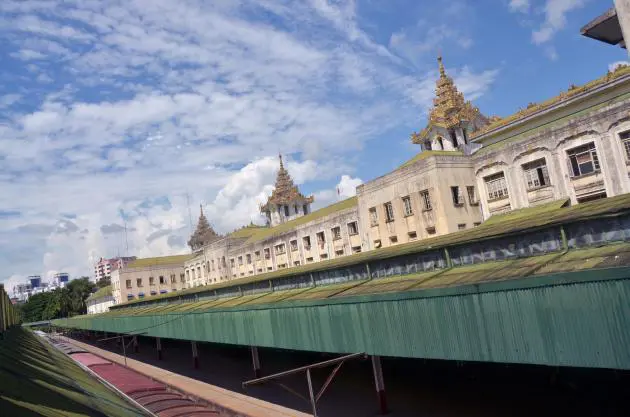
The privatisation plan will allow private companies to operate the railway network under the ministry’s supervision, including the Yangon Railway Station. For the operations, joint ventures with the private companies will be established.
The minister noted the decision was driven by the operating losses, of about Ks 45 billion per year.
“Railway services are operating at a loss. This is a global phenomenon. Japan’s system, considered to be the best in the world, is also making losses. Our system also suffers a loss of Ks 45 billion per year,” he added.
The ministry is in the process of attracting investment bids from private companies. Joint ventures are planned for the operations of the Bagan-Kyaukpadaung and Mandalay-Myitkyina routes.
To make the deal more attractive, the ministry has given the green light to the bid winner to run advertisements on the Yangon circular trains.
In the past three years, the ministry has accelerated its efforts to upgrade the railway network, mainly with assistance from Japan.
All trains on the Yangon circular route will soon be fitted with air conditioning units, as part of the upgrade intended to turn it into the primary mode of public transportation in Myanmar’s largest city, the Ministry of Rail Transportation said.
It manager for Yangon Region, Zaw Pe Sein, said the plan had already been finalised and will be implemented next year. The ministry also assured that fares will be affordable to all classes of society. Current fares for air-conditioned trains have been cut to Ks 300 (US$0.3) from Ks 400.
More fare reductions will be made, the ministry said recently.
The upgrading of the circular route is one of two projects for improving public transportation. The second is the construction of an elevated train, which is expected to begin next year.
The ministry has said the upgrade of the circular train route will be conducted in phases over several years.
Yangon Region transport minister Aung Khin also said recently that construction of an elevated train will begin next year and it will follow the route of the existing train system used by about 100,000 commuters a day.
The new commuting option is intended to reduce traffic congestion in the city and, according to officials, will be built with Japanese aid.
Japanese engineers are already working with the regional government to upgrade the existing train system, known as the circular train, in Yangon. The aim is to upgrade its service so that it can handle up to 3 million commuters a day by 2020, according to officials at the Ministry of Rail Transportation.
Aung Khin provided few details about the planned elevated train, except to say it would follow the route of the existing train and include air conditioning.
Meanwhile, main roads in downtown Yangon such as Theinbyu and Boaungkyaw Roads will be widened this fiscal year to ease growing demand for parking lots, Yangon City Development Committee has said.
“We plan to widen main roads and some others in six townships in the downtown area. The number of roads hasn’t been set yet. But I’m sure Theinbyu and Boaungkyaw roads are included,” a YCDC official said.
New parking lots will specify service fees, he added.
The lack of parking areas has contributed to traffic congestion in the city centre. Some main roads were widened last year, including Anawyahta, Merchant and Strand Roads, however traffic jams in those areas have not diminished as expected.
At present, nine car parking zones have been designated in six townships. They charge Ks 200 (US$0.2) an hour for cars.
The city administration transferred some parking lots to private hands, and it receives Ks 1.4 billion ($1.4 million) annually for this, according to YCDC figures.
