
First statewide exams in 24 years


Play
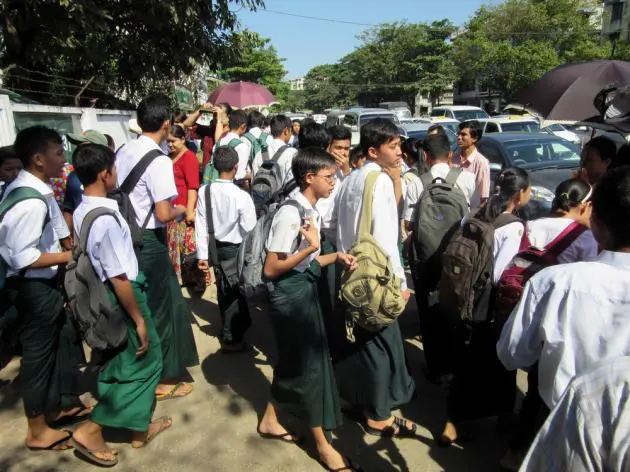
On December 16, students in Grade 5 and Grade 9 joined the preliminary district-, region- and state-level exams, marking the first time such exams have been administered since 1990.
“We have coordinated at various levels to hold these exams. They are not meant to get students in trouble. We will form a working group to design questions that will test students’ abilities and show us how to teach them. The experts will decide what questions will be included. We have also trained teachers to make questions,” said an unidentified official from the education department.
Some educators support the idea of state-wide exams.
“We welcome this kind of education system. The exam includes the whole curriculum from Grade 1 to Grade 11. With this kind of exam system, we will test students’ abilities and avoid awarding undeserved certificates. It is a step toward improving Myanmar education, which has lagged for many years,” said Dr. Soe Win Oo, Chairman of Myanmar Private Teachers Association.
However, there are some critics of the exams.
“I don’t like this kind of exam. At a time when we are moving toward a free and decentralised system, holding this kind of exam shows that basic education is still controlled by the central government. The education system is regressing back into a centralised system. Exams should differ at each school. I don’t think the centralised system should apply now,” said an unnamed school principal.
The exams starts will be administered between December 16 and December 23.
President Thein Sein pledged in his inauguration speech in 2012 to improve education and seek foreign expertise to lift standards to international levels. The Myanmar government has made reform of the entire higher education system a national priority. One of the main drivers is the recognition of the important role of human capital to the economic development goals of the country.
Official statistics show that there are 41,000 state-run basic education schools in the country where more than 8.1 million students are pursuing education under the guidance of more than 270,000 teachers. In the higher education sector, the country has 161 universities and colleges. Yangon is home to 33 universities, while Kayah state has the fewest: three
In a country where 70 per cent of population lives in rural areas, there is growing demand to improve the quality of education in the rural areas.
