
Exact date for national ceasefire signing is not set yet: minister


Play
Efforts are under way to achieve the nation-wide ceasefire agreement before February 12, said a government peace negotiator. Though, he could not confirm the exact date of the signing.
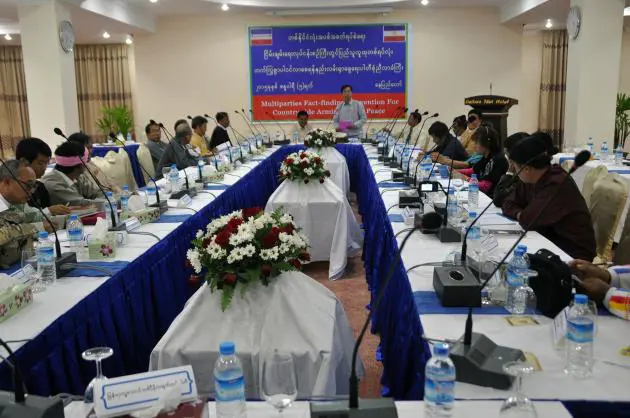
Union minister Aung Min, who also serves as vice-chairman of the Union Peacemaking Working Committee (UPWC), said President Thein Sein and 12 ethnic armed groups discussed the points that have yet to be compromised for the national ceasefire in Nay Pyi Taw on January 5.
“In meeting with the president, the ethnic leaders expressed their demands. The president himself told them as much as he could,” said Aung Min.
“More trust can be built as the President takes responsibility for some issues. So we can say the peace process is moving forward. While an exact date is not set, we are trying our best to sign a nation-wide ceasefire agreement soon.”
Primarily, all parties aimed to have the accord signed before the Union Day, which will fall on February 12.
Pado Saw Kwe Htoo Win, general secretary of the Karen National Union, said: “On February 12 (Union Day), the name ‘the Union of Myanmar’ emerged. We have two reasons to sign a nation-wide ceasefire on Union Day. First, both parties are trying to reach a ceasefire agreement. Second, we made lots of compromises in the latest coordination meeting. We have only a few points to discuss, and will continue our coordination. All can agree to seek coordination before February 12.”
Colonel Khun Oakka, leader of the Pao National Liberation Organisation, said the talks between the NCCT and UPWC are close to achieving their goal. However, he said the nationwide ceasefire deal could be signed only if the problems of renewed violence between the Myanmar Army and ethnic armed groups could be solved.
The government invited all the 16 ethnic armed groups to discuss the ceasefire. However, four armed groups - the Kachin Independence Army, the Ta'ang National Liberation Army, the Karenni National Progressive Party and the Chin National Front - could not attend the talks for various reasons.
Earlier, the UPWC and Nationwide Ceasefire Coordination Team (NCCT), comprised of representatives from the ethnic armed groups, held a meeting in Yangon on December 22 and 23 to discuss the remaining eight out of 103 points included in the nation-wide ceasefire draft. After the discussed points have been approved by the armed group leaders, the whole ceasefire draft could be finalised, he said.
In another development, as President Thein Sein met the leaders on January 5, on the same day 53 political parties including the ruling Union Solidarity and Development Party discussed on public participation in ceasefire talks.
According to MP Dr Aye Maung, chairperson of Arakan National Party, the meeting was planned a week earlier. The parties focused on a proposed joint campaign to collect public opinions throughout the country; public sessions to share knowledge on the ceasefire talks; and the formation of public peace committees.
“The campaign will require a lot of money,” said Aye Maung.
He was also concerned that some ethnic groups may not take part in the ceasefire accord.
He noted that Section 17-(1) of the Unlawful Association Act is now an obstacle for ethnic groups to sit at ceasefire talks, as their positions are not warranted as political parties.
He also suggested political parties establish a joint peace working committee similar to Myanmar Peace Centre, the government’s think tank which is devoted for peace talks.
Further, he pointed out that the armed ethnic groups have become stronger. Therefore, the government should revise its problem-solving methods.
“There should be equality and self-regulation for ethnic nationals to solve the conflicts. It’s time for the government to prove its high-mindedness.”
