
Education minister bows to students' demand


Play
Union Education Minister Dr Khin San Yi said measures would be taken to amend some provisions of the National Education Law following protests against the law by students across Myanmar.
Parliament also recently announced that the education ministry is due to submit a bill to amend the education law for parliamentary discussion.
A coordination meeting on the law’s amendment took place on Tuesday with comments by the deputy speaker of Union parliament, Lower House deputy speaker Nanda Kyaw Swa, Education Minister Khin San Yi, Deputy Education Minister Dr Zaw Min Aung and chairmen and members of parliamentary committees.
The amended version will be discussed in the Union parliament.
Since the law came into effect, students across the country have publicly protested the centralisation of the education system, called for the elimination of the National Education Commission and the Higher Education Coordination Committee and demanded freedom to form student unions. They also demand the insertion of all-inclusive education into the law and the development of ethnic minority cultures and literatures.
The Union parliament passed the education law last September with 46 per cent of the provisions made by parliament and 54 by the education ministry.
A major protest was hosted in November. Another one started on January 20 by dozens of students who were displeased with the government’s inaction. They started marching from Mandalay to Yangon to demand changes to the education law. As they have passed the first 100km of the 575-km journey, they have received overwhelming supports from villagers.
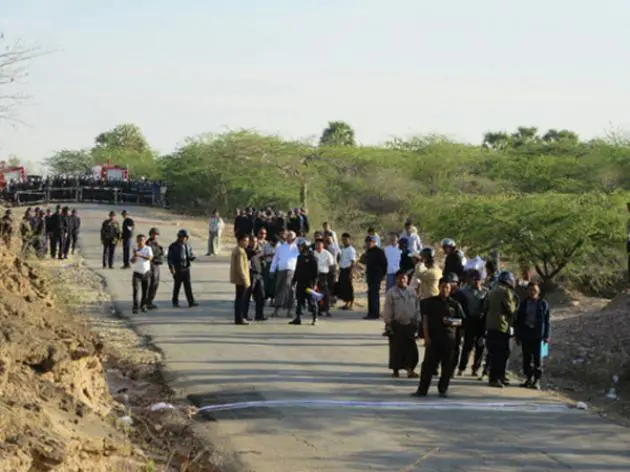
On Tuesday, when the procession of some 300 people – comprised of students, monks and other activists – was marching through the Nanmyint valley, they were briefly blocked by Myanmar police.
"We are trying to stop them to avoid further tension and instability," government spokesman Ye Htut told AFP, adding the strength of the security response would be down to local authorities.
Fearing another bloody clash, more than 60 NGOs in Myanmar urged the government to avoid using force against the students.
Aung San Suu Kyi, the chairperson of the National League for Democracy (NLD), said all parties must prepare to compromise on the controversial national education bill.
“One mustn't take a stance carelessly. Democracy requires compromise and negotiation. The students have raised many different grievances. I don’t know how the government and the students reached an agreement. I did not participate in the drafting of the bill. I am not on the national education committee. But I am interested in this issue,” Suu Kyi said.
“Compromise is reached through negotiation in any country. One side can’t solve the problem alone. All parties need to prepare to compromise. Compromise means agreement made between two people or groups in which each side gives up some of the things they want so that both sides are happy at the end. It is a basic culture of democracy,” Suu Kyi said.
“If we want democracy, a solution must be sought through negotiation. If not, democracy will not take root in our society. If both sides have genuine desires to solve the problem through negotiation, a solution will be found. If both sides want to discuss only things they want, a solution will be impossible,” Suu Kyi said.
“This matter concerns us all. The people discussing the matter must understand the situation well and must be skilful. Amendments should be made. They should not stick to a dogmatic approach in the compromise. By-laws have not been specified until now. Some said by-laws are not required. This bill absolutely needs by-laws,” Suu Kyi said.
More than 60 NGOs in Myanmar Tuesday urged the government to avoid using force against students marching from Mandalay to Yangon to demand changes to the education law.
The students were demanding talks on amendments to the National Education Law. These included the establishment of independent student and teacher unions, changes to exam and entrance requirements at universities, the introduction of ethnic languages, and a modernisation of the national syllabus.
"We found the education law is very undemocratic and restricted students' rights. According to it, we can't form a student union, and we have to stay away from politics," Ye Yint Kyaw, a spokesman for the All Burma Federation of Student Unions, told DPA.
According to Ye Yint Kyaw, while some of the student leaders would discuss with the authorities over the law amendments, the rest would continue marching to Yangon.
On Monday night, police surrounded a monastery compound in Myin Chan township where the students were staying the night but no violence was reported.
On Tuesday, Myanmar police briefly blocked the path of a major student protest march.
Student activism is a potent political force in former junta-run Myanmar, with young activists at the forefront of several major uprisings, including a mass 1988 demonstration that ended in a bloody military assault on demonstrators.
The group was intercepted in a remote rural area in the Mandalay region, around seven miles (11 kilometres) from the nearest village, and local police told AFP they had been asked to send personnel to reinforce the roadblock.
They added that the group had been allowed to pass in the early evening, but did not give a reason.
Activists earlier said that the situation was tense but calm.
"If we cannot continue we will sit and continue our protest," Paing Ye Thu, a student in contact with the protesters, told AFP.
