
Myanmar Buddhists provide model education


Play
Inspired by Christians, a school challenges govt in moderning education system
Mandalay - At nearly 70 years old, and a lifetime in the Buddhist monkhood, Ashin Nayaka is breaking the mould in Myanmar- but not because of his faith.
He is abbot of the renowned Phaung Daw Oo school in Mandalay, the country's second-largest city. It offers thousands of pupils a type of education that had previously been the preserve only of students at Christian missionary schools.
"My brother and I learned the way Christian fathers taught the students in the missionary school," he told dpa as some 30 students played football in a small playground in the monastery compound.
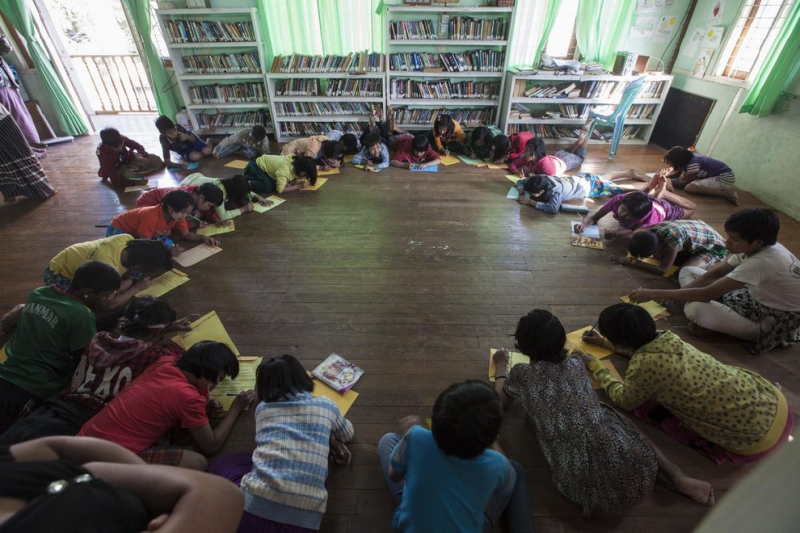
In a classroom, children in white and green uniforms were playing a card game with pictures of animals, fruits, vegetables and colours.
"We were inspired by their way of motivating students, and dreamed of founding such a school ourselves," said Ashin Nayaka, 69, whose staff includes about 400 teachers who provide free education to more than8,000 pupils. Monastic schools traditionally used rote learning rather than a child-centred approach favoured by teachers from the West that encouraged more creativity. When he was a teenager he saw the difference first-hand at a Christian school, and was inspired to follow what became his life mission, leading to a nomination this year for a prestigious international teaching prize.
In order to pursue his dream, he had to educate himself first. He attended government schools in Mandalay and graduated with a university bachelor's degree in chemistry at age 35 in 1981.
"I was the oldest student in the class. So, some people laughed at me, but that's okay," he recalled.
After being appointed abbot of Phaung Daw Oo monastery, he started a school in 1993 for primary students, especially children whose families could not afford to pay the minimum fees at government schools.
"We, the teachers, had to learn the child-centred approach first with the help of foreign volunteers," he said.
His efforts to develop a teaching method radically different from the one used by the country's rickety public education system are now being recognised internationally. He is among the top 50 of 8,000 nominees from 148 countries for the1-million-dollar Global Teacher Prize, the first Buddhist monk and Myanmar teacher to be shortlisted.
Chloe Smith, project coordinator at the non-profit New Education Highway, said the abbot can inspire other Myanmar schools to improve their teaching and organisational style.
"Paung Daw Oo is a very famous monastic school which seems to strive towards a more engaging education model," said Smith, who also trains teachers at monastic schools.
"Monastic education plays a very big role in Myanmar society, because government schools are overcrowded and parents must pay for their children to attend, which they don't always have enough money for.” Moreover, the current system is deficient because it focuses on rote learning for exams, rather than having children engage with and process the information they are given, she said.
"We need to change the mindset of the authorities. They are still thinking that students should just be under pressure to pass exams," said Thein Lwin, head of the National Network for Education Reform.
Along with student unions and civil organisations, the network opposes the 2014 National Education Law for maintaining centralised control of universities and resisting education reform.
In fact, change is already under way. The Ministry of Education has launched a scheme with international partners to replace its outdated curriculum and introduce tests that take more than memorisation and recitation to pass. Monasteries are likely to remain a major part of the education system however. There are currently 1,538 monastic schools providing free education to nearly 300,000 primary students across the country, according to the Monastic Education Development Group, which Ashin Nayaka chairs.
"We have hired 7,584 teachers, but some are volunteers," he said. "We have to rely on donations," he said. "Even many rich Muslim people donate to our school, as we offer free education to all students no matter what religion they follow," Ashin Nayaka said.
During the worst violence that occurred in Mandalay in 2013, some Muslim men guarded the monastery day and night from possible attacks, abbot Ashin Magainda recalled. "I also believe in them as they are like my children," he said.
As for the Global Teacher Prize, he said: "Yes, I want that prize, but not for me. Just to inspire others to improve the crumbling education system."
