
BEYOND THE OKAY CHORALE


Play
A Polish women's chorus seeks |to restore a lost theatrical tradition
The discussions about “theatre beyond theatre” that took a member of the Thai dance and theatre critics’ association to Warsaw last month for a gathering of the International Association of Theatre Critics afforded a chance to see a pair of Polish performances.
And it would be great if the Polish Embassy in Bangkok could bring Chor Kobiet (Chorus of Women) here – if only to show Thais that “chorus” doesn’t necessarily mean a group of singers at stage left.
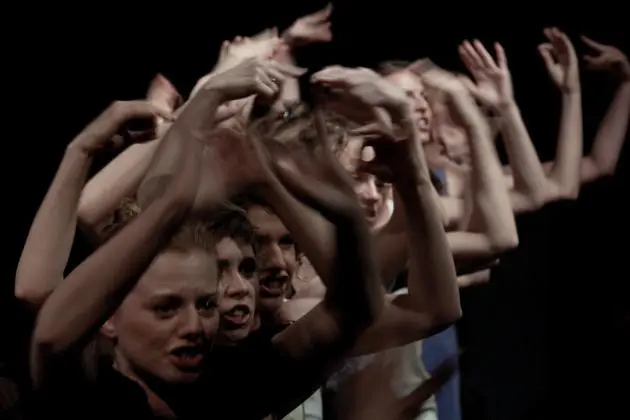
Marta Gornicka’s troupe has performed “This is the Chorus Speaking” at festivals in France, Germany and Britain and has appeared in Japan and India. Thailand should see that piece rather than the new “Magnificat”, described as “a statement about the woman in the Church’s system of power”.
Backed by the Zbigniew Raszewski Theatre Institute, Gornicka auditioned women for her chorus in 2009, training those she selected – who were not experienced actresses or singers – in movement and sound.
“Modern drama has done away with the chorus, thus depriving itself of a certain dimension of the tragic,” Gornicka has pointed out. “We must restore the chorus to the stage and find new forms of its theatrical presence. We have to restore women to the chorus.”
The point is proved in “This is the Chorus Speaking”.
The 50-minute presentation is musically pleasant and dramatically engaging. Its libretto comes from such diverse sources as “Antigone”, Roland Barthe, advertising slogans, cooking recipes and movie quotes.
Moments of silence served as punctuation marks, giving listeners time to digest the words, though I wish there’d been more time, given the many messages conveyed, and more time as well to simply look at the singers as women, not “characters”.
Their different voice levels, from whispers to shouts, and the solos and duets that sprang out of the choral formation made the performance unpredictable. Gornicka conducted from the front row of the audience, her energy matching the combined vivacity of all the singers put together.
Barefoot in plain gowns of white, grey and black, the 25 women stood, walked and reclined on a slightly raked stage, forming varied patterns that occasionally looked like choreographed dance.
The singers ranged widely in age and character, like any sampling of citizens from daily life. It was a stark contrast to women’s typical roles in theatre, film and TV these days, which bear little in common with real life. As one the older performers declared, “We, women, are differently monstrous – we are monstrously different.”
Choruses in ancient Greek theatre were of course even more significant than the actors out front. Gornicka is re-examining that tradition and giving the chorus modern relevance. It’s also a noble experiment in restoring the relationship between arts disciplines.
The writer’s trip was supported by Culture Ministry’s Office of Contemporary Art and Culture.
ON THE WEB
www.ChorKobiet.pl.
