
Strangely, into the night


Play
Two highly experimental dance theatre shows conjure up food for thought
There was plenty for Bangkok dance and theatre enthusiasts to enjoy last week with two experimental works being served up in unconventional performance spaces.
Japan’s cutting-edge performance company faifai staged their new take on a well-known traditional Japanese story “Shibahama” at Sonic on Soi Ekamai, after tours in their home country and Europe. They billed their performance as a wild mash-up of the traditional Japanese sit-down comedy Rakugo, contemporary dance, game show and theatre.
The word “wild” was almost an understatement, as faifai took the audience on a weird and wonderful journey with drunken fishmonger Kuma-chan and his discovery of a fortune. It was never clear if his luck was real or merely a dream and the venue also echoed this thin line of uncertainty.
Bangkok’s new indie nightclub was still serving drinks and welcoming its usual guests outside while doubling as a surreal seashore with colourful beach toys scattered around and people dancing about in fish costumes. Live and recorded sounds reverberated from iPhones, portable speakers, and the club’s main sound system.
The story was taken apart, set free from its traditional frame, in an attempt to explore human weaknesses and relate it to contemporary viewers. Kuma-chan’s ambition to become stronger was demonstrated in a boxing match with an invited muay thai artist, and his desire for easy cash was transformed into a rock-paper-scissors tournament with prize money, in which the audience participated.
His complex about the size of his manhood was also turned into a bizarre dream: he invited the audience into the club’s bathroom, turned off the lights, and let loose a glow-in-the-dark dildo amidst hysterical laughter.
Some jokes should be used only once, however. The second time Kuman-chan flashed his dildo was less funny. The show also relied too heavily on verbal understanding towards the end, and with the performers speaking Japanese and the surtitles impossible to read under the bright spotlights, much of the meaning was lost.
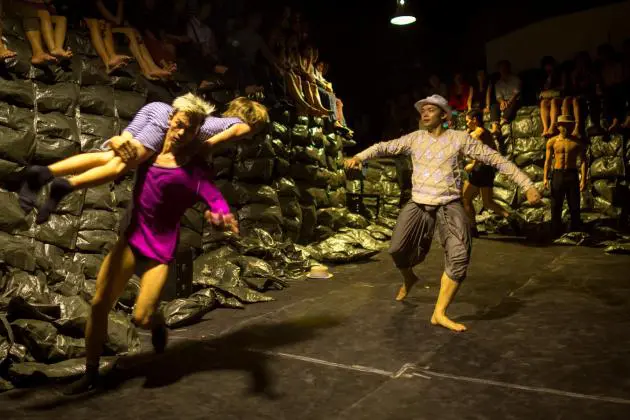
Later in the week, Jitti Chompee and his 18 Monkeys Dance Theatre reinterpreted Thomas Mann’s classic “Death in Venice” in the heart of Sukhumvit, inside an empty swimming pool lined with black sandbags.
Despite being staged right below the audience, challenging the choreographer, performers, as well as the lighting designer, the performance worked well.
Compared to his previous productions, Jitti’s choreography for “Demon in Venice” was more grounded and offered a smoother blend of different dance forms. Unlike “A Love Song”, there were no obvious, separate chunks of contemporary, khon and break dance.
The dancers, who could have been neater with their steps, possessed great strength and were able to execute acrobatic steps and sweeping swirls on the floor with their bodies intertwined. The contact between the bodies and performance space also created interesting beating sounds. The lights were hung above and into the pool with no attempt to hide the wires, creating a dark, raw ambience that heightened the show’s tension even further.
Anucha Sumaman, with his delicate khon arm movements and poised body, aptly assumed the role of the nobleman Aschenbach who descends into madness and ultimately death because of his confused obsession with the beautiful young Tadzio (Aeneas Compernol). Starting by resisting the boy’s beauty with staccato movements, Aschenbach ended stooping to his desire, dragging the tail of the wedding dress he had put on pathetically around the pool before curling up lifelessly on a lone chair.
The theme of repressed homosexuality was also explored in a more light-hearted manner in the scene where the dancers played beach volleyball with Tadzio. The balls naturally led the underwear-clad dancers to joke about sexual acts. To the majority of the audience, this scene might have been refreshing comic relief. I personally felt a little uncomfortable that it was done in front of an underage boy who didn’t have many clothes on himself.
True, it was for an artistic purpose, but I couldn’t help wondering if there might be other and better ways of addressing sexuality in art without going overtly below the waist.
