
He sees solutions everywhere


Play
An exhibition in Mito, Japan, shows just how clever architect Shigeru Ban is
Architect Shigeru Ban, 55, is acclaimed worldwide for his use of unconventional but ubiquitous materials. For people who have been affected by disasters in Japan and overseas, his style has a special relevance.
The exhibition “Shigeru Ban: Architecture and Humanitarian Activities”, running through May 12 at Art Tower Mito in Mito, presents an opportunity for visitors to think about the role of architects in society.
Ban’s entire career is illustrated through 63 of his projects. The exhibition includes miniature models, building materials and even entire structures – albeit small ones. The exhibition includes shelters for those who lost their homes in the Great East Japan Earthquake on March 11, 2011, and public buildings that aim to foster connections with people from all walks of life.
One remarkable part of the exhibit displays paper tubes that stand like the columns of an ancient Greek temple inside the exhibition venue.
Ban started making buildings with paper, his signature material, in the 1980s after discovering the usefulness of prefabricated paper tubes made of recycled paper. After developing them through trial and error, he had them certified as a building material.
When he designed the Japanese pavilion at the Expo 2000 in Hanover, Germany, his dome constructed using paper tubes received a great deal of attention. “Paper tubes are inexpensive and easy to obtain across the world,” Ban said. “Because they are lightweight, even amateurs can use them to build structures. They also are sufficiently strong.”
Ban made use of such merits in post-disaster reconstruction projects.
In the wake of the Great Hanshin Earthquake in 1995, he built the Paper Log House and the Paper Church in Kobe, which was hardest-hit in the disaster. A decade later, the church was donated to an area hit by a major quake in Taiwan and is still in use.
After the 1995 earthquake, Ban set up the Voluntary Architects’ Network (VAN), a non-profit organisation providing support to disaster-hit areas in Japan and overseas.
He has also taught many students while serving as a professor at Keio University from 2001 to 2008 and at Kyoto University of Art and Design since 2011. In his classes, he makes students aware of the social contributions of architects by involving them in the actual building of the structures.
Ban has also contributed to the region hit in the 2011 disaster.
He devised a paper partition system, which was installed at facilities for evacuees to help them maintain a degree of privacy.
For Onagawa in the region, he designed temporary housing facilities for evacuees. Each unit is constructed using stacked shipping containers.
The containers are built according to the same specifications worldwide and are therefore easy to obtain anywhere, Ban said.
Ban previously used shipping containers as building blocks for a portable museum for an exhibition tour held in Japan and the United States.
Ban was also commissioned to design a temporary church constructed from paper tubes for victims of the massive earthquake in Christchurch, New Zealand, in 2011. The building is slated to be completed around May.
“I’ve slightly altered existing industrial products and used them for other purposes,” Ban said. He adopts the same approach whether designing temporary housing facilities or luxury brand shops.
In the latter category, the Nicolas G Hayek Centre, a collection of wristwatch showrooms of the Swatch Group in Tokyo, has a glass shutter facade that makes the building look open and inviting. Ban said this approach to design is normally used for factories.
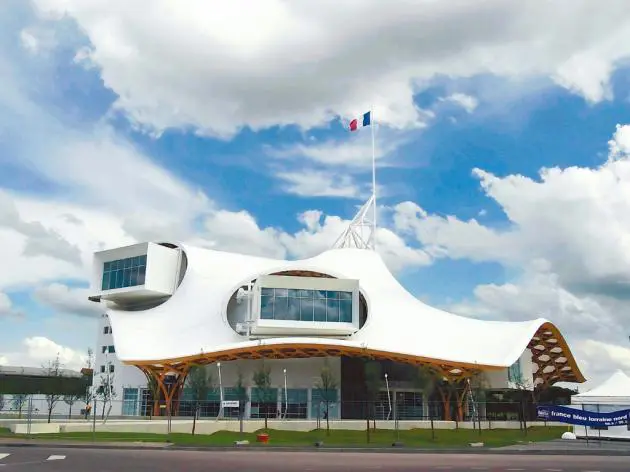
The apotheosis of his design methods can be found in the Centre Pompidou-Metz, an annex of the Centre Pompidou Paris completed in Metz in eastern France in 2010.
The building has a large roof suggesting either a straw hat or the roof of a circus tent. To attract people who are not necessarily interested in art, the first floor is designed to be open and to make it easier for visitors to come and go.
The design of the Oita prefectural museum, slated for completion in 2015, is also intended to be open to the local community.
Before the 2011 disaster, the Art Tower Mito had asked Ban to hold an exhibition at the recommendation of Arata Isozaki, 81, the renowned architect behind the Mito building who also has served as an art adviser. After Mito was shaken by the 2011 disaster, holding the exhibition there became even more meaningful.
Curator Sayako Kadowaki said: “I wanted to display 3D works so that visitors can feel and experience Ban’s style. I also wanted to show his paper-tube installations.”
