
The vivid glow of tradition


Play
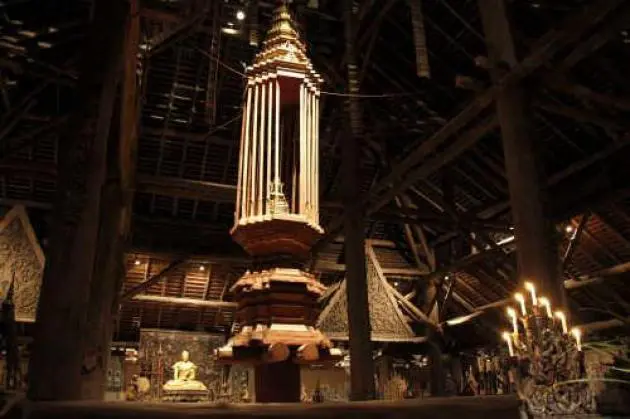
Candles light the all-teak Hor Kham in Chiang Rai at night
WE TAKE electricity for granted so much today that power cuts are cause for alarm – and that’s also usually the only time we light a candle. It’s hard for younger people especially to imagine a past when blazing bulbs weren’t in complete control of the dark of night.
But, as the Mae Fah Luang Art and Cultural Park in Chiang Rai is demonstrating, candlelight has a utility just as powerful.
See for yourself whether candlelight is the best way to illuminate history with an evening visit to the park’s wonderful Golden Pavilion – the Hor Kham – which is staying open until 10pm this month and next.
It’s a chance to bathe in the glow of the past. The absolute calm in the midst of more than 100 century-old and exquisitely carved Lanna-style candelabras is deeply moving.
Set in a beautifully landscaped botanical garden, the Hor Kam quietly glimmers with the soft, faint lustre of the multitude of candles, revealing the deep beauty of the teak relics, many of them sacred.
“People today aren’t accustomed to serenity. They work hard and what they need afterward is something quick and energetic,” says the park’s director, Nakorn Pongnoi. “Drawing people a place as tranquil as this is tough! So we’ve lit the museum with candles in the hope of luring some of them away from the bustle of the night bazaar and the Mae Sai border market.”
The Mae Fah Luang Foundation’s Art and Cultural Park acquired many teak cultural objects in the 1980s that were on the verge of being destroyed or sold to foreign collectors – or at least deteriorating to the point of worthlessness. When the Hor Kam was built in 1984 for the birthday of Her Royal Highness the Princess Mother, the collection found a new home.
There’s a century-old, Burmese-style Buddha carved from a single teak tree that was 450 years old. There are also several tung kradang, the wooden standards attached to a pole, as well as chests specially made for storing dharma books.
The wooden candelabras – known as sattpan – from eight northern provinces form the highlight of the display. The Hor Kam is itself all teak, the wood coming from 32 traditional houses in a reverent gift to the Princess Mother from citizens of Chiang Rai and Phayao.
Within the Hor Kham’s finely grained walls, the ornately carved candelabras are by night dimly lit and yet utterly elegant. Each one would have once stood in front of the main Buddha image in a temple, its light a window through which the Lord Buddha and his devotees could commune. The glow of the candles was a holy light indeed.
“The size of the candelabra depended on the size of the ubosot,” says the park’ supervisor Attapol Laoyawanit, referring to the temple’s consecrated assembly hall. “The larger the ubosot, the larger the candelabra. You can still see one at Wat Phrathat Lampang Luang in Lampang, but it’s never lit anymore.”
As well as their remarkable craftsmanship, the candelabras boast deep symbolism. Buddhism in Lanna culture is closely related to the Hindu faith, even more so than elsewhere in Thailand. There are seven candleholders, representing the seven mountain ranges ringed around Mount Sumeru, the pinnacle of the gods in Hindu cosmology, and the sevenfold path to nirvarna.
Among the legends that accrued around the Buddha’s story, one tale has it that his relics were taken to Mount Sumeru, atop which rested the Heaven of Indra. In temples, the chief Buddha image represents Sumeru.
Prominent at the centre of the Hor Kham is a wooden Buddha statue called Phra Pratoh, which inscriptions indicate was sculpted with a pra, a cleaver, in 1693. Its unadorned surface signifies the truthfulness of Buddhism. Phra Pratoh’s Mount Sumeru is a prasat, a slender, tiered “roof” structure set high on a pedestal supported by hundreds of bodhi figurines.
Lanna candelabras were normally carved from teak and decorated with lacquer and gold leaf. The motifs were typically blooming flowers, vines and the naga serpent, a symbol of prosperity, with its coils bathed in golden or aqua light.
Teak, which is relatively hard, was favoured because it resists termites, rot, fungi and mildew. “With its beautiful grain and texture, teak is easily carved and won’t splinter easily,” says Attapol. “And it doesn’t shrink much, so it’s well suited to places where there are periodic changes in moisture. The North was always a rich source of teak.”
Most of the candelabras are triangular in form, but Attapol points out an unusual square one from Nan. It’s also hollowed out, providing a cavity for keeping incense and the candles.
Another one from Phrae is more Western in style, probably reflecting the influence of European missionaries who were here during the reign of King Rama V in the 19th-century.
A piece from Chiang Mai has a scroll of flowers carved around all three sides and naga at the base perched atop a herd of elephants, with the three-headed Erawan carrying Phra Phrom at the centre. The naga occupies the centre of the universe, protecting all that is sacred.
A candelabra from Lamphun features an angelic being praying and offering flowers, surrounded by mountains and clouds. The nails keeping the candles in place are square iron rods.
Attapol explains that the light of popularity gradually faded on candelabras amid fear of fire in these all-wood buildings and the increasing use of altar tables brought from the central region. Sure enough, electricity virtually finished off the custom.
TRANQUIL EVENINGS
>>The Mae Fah Luang Art and Cultural Park in Chiang Rai’s Muang district is open daily (except Monday) from 10 to 10, today through January 30. The antique candelabras will be lit from 5 to 10.
>>Admission is Bt100 for Thais, Bt200 for foreigners, Bt20 for students and free for children under 12.
>>Find out more at (053) 601 013 and www.MaeFahLuang.org.
