
New blood for an old art


Play
A growing number of young people are discarding the digital lifestyle to form Peking Opera troupes
Liu Feng doesn’t spend weekends going to karaoke bars or cinemas. Along with a dozen of his friends, the graphic designer drives for over an hour to Shijingshan district in western Beijing.
Well outside the downtown area, Shijingshan tends not to draw the crowds but listen carefully and you’ll hear the sounds of such traditional Chinese instruments as erhu, drums and cymbals ringing out from a small theatre inside Shijingshan Cultural Centre.
With several big suitcases holding their costumes and stage settings, 31-year-old Liu and his friends arrive there at 10am and start preparing for their performance, which starts at 2.
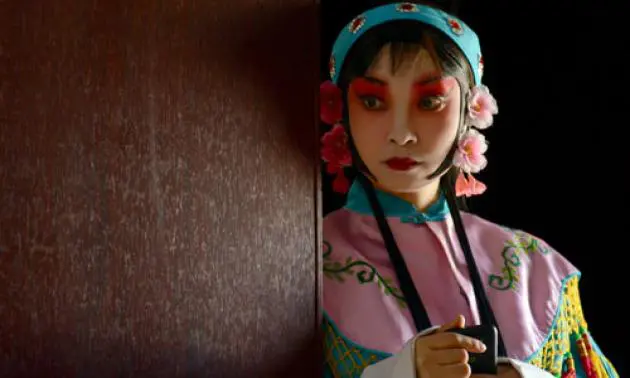
With colourful makeup, bulky costumes and long swords, Liu and his friends stage a classical Peking Opera piece “The Dragon and Phoenix Hall” for an audience of more than 200.
After the show, they wash their faces and return to reality as ordinary young people, who work at different jobs, from a satellite engineer to a senior advertising manager.
Some experts worry that Peking Opera may die out, but younger fans like Liu have been working hard to revive it.
Together with members of Beijing Youth Peking Opera Troupe, which Liu co-founded in 2005, they have performed at the theatre on weekends for two years.
“I fell in love with the Peking Opera in university, when I took a course about costumes. The beautiful embroidery caught my eye,” says Liu, a Beijing native. “I once bought a robe for over 10,000 yuan (Bt52,000). My mother said I was crazy.”
The troupe started with six people and now has over 30 members. They gather every weekend to train, rehearse and perform.
Thanks to support from government institutions like the Shijingshan Cultural Centre, which offers the venue free, people still have places to enjoy the ancient art form.
“They are amateur Peking Opera actors, but they perform like professionals,” says Wang Yubo, the centre’s and a former student of Peking Opera.
He also points out that older people stage Peking Opera mostly for fun but young fans do lots of research and approach it as a career.
“They gain a lot from their hard work and they respect traditional culture,” he says.
Amateur groups like the Beijing Youth Peking Opera Troupe are springing up all over the city and many of them look to the Shijiangshan Cultural Centre for their main stage, according to Wang.
Liu Fei, a 36-year-old doctor from Beijing, founded Yong Cui Peking Opera Troupe in 2004. All the members have stable jobs and good incomes to support their passion.
“It’s not a short-term thing since Peking Opera is sophisticated. The more you learn, the more you love it and the more you want to devote to it, both financially and spiritually,” Liu says
“There is a generation gap in Peking Opera,” Liu continues. “While people in their 70s and above have strong interest since Peking Opera was a main entertainment in China decades ago, people of my parents’ age, around 50 to 60, have little interest due to the ‘cultural revolution’ (1966-76). Now, a large number of young people, including white-collar workers and students, are picking it up.”
The most fascinating part of Peking Opera for him is the traditional Chinese values and virtues told through the stories, such as patriotism, loyalty and filial piety.
Liu grew up near the Beijing Peking Opera Theatre, which is home to many veteran Peking Opera performers, and he would often watch them train and rehearse.
According to Li Shisheng, a Peking Opera master from Beijing, the art form is very difficult to learn. It requires a totally different style of singing and special breathing techniques. What’s more, some plays require difficult actions such as doing the splits or fighting with swords or spears. Performers also have to remember hundreds of lines in ancient Chinese for each play.
“It takes much more effort for those amateurs since they have to work in the daytime,” Li, 67, says.
He started to teach members of the Beijing Youth Peking Opera Troupe six years ago and spends three hours on the road every weekend to teach.
Though the “cultural revolution” prevented Li from making a career of his childhood passion, he practised it every day while working in a factory.
Now, his son and daughter-in-law are performers at the Beijing Peking Opera Theatre, and Li says that he is happy to continue his dream via working with young people.
“I want to teach my students the most authentic and traditional Peking Opera,” Li says, scoffing at some recent efforts to give the art a modern edge with big-budget stage sets and other visuals.
“I believe that the most attractive part of Peking Opera is its original look,” he says.
Liu Feng, too, seeks the art in its roots.
“Like traditional Chinese painting and calligraphy, the beauty of Peking Opera lies in its expression. It also takes time to learn it, from an eye contact to a footstep,” he says. “In the beginning, it was a hobby and now we see it as a responsibility.”
