
Our shrinking world


Play
Philips looks to the future with portable medical technology that could save lives
From giagntic MRI scanners to wireless portable blood pressure monitors, today’s healthcare technology is constantly being developed to make life healthier and better. High-speed links using 3G or 4G are increasingly being pressed into service to ensure those who live far from health facilities have access to diagnosis and treatment.
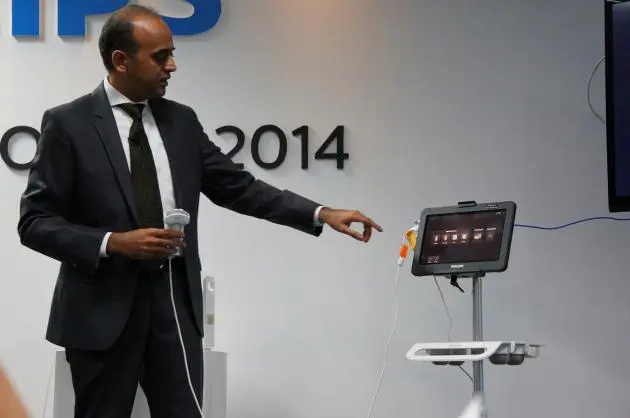
Two clever machines that could make a massive difference to the way healthcare is provided made their debut earlier this month at the Philips Global Media Onsite 2014 event held at the Philips Innovation Campus in Bangalore, India. The cutting-age portable ultrasound and ECG machines, both developed at the PIC Bangalore, were introduced to media from nine countries around the world.
The ultraportable Visiq ultrasound shrinks the machine from its laptop-like size with transducer probe into a transducer probe only and can be plugged in and played on any tablet, TV monitor or computer screen.
It has been developed to respond to the problem of maternal death. A recent study revealed that 40 per cent such deaths occur because of a lack of access to basic equipment, particularly ultrasound. This is still a major problem in India and is also common in rural Thailand, where women in remote areas are unable to visit doctors for proper check ups during pregnancy
According to Dr Sujit Kumar, general manager of Philips Healthcare’s Ultrasound Business, 90 per cent of the machine has been shrunk into the probe. The Visiq ultrasound will be on the market this year and will cost about 50 per cent less than the usual ultrasound.
It delivers enhances image quality and allows clinicians to increase access to quality diagnostic scans. This device can have a huge impact in providing quality diagnostic healthcare in developing countries like India where more than half of the population lives in remote areas lacking access to quality healthcare or people who live in remote area. In Thailand, it would benefit health workers at community clinics or even a village health volunteer who goes out to the remote areas.
With cardiovascular disease now the No 1 killer, Philips’ new portable electrocardiograph, aka ECG or EKG, could literally mean the difference between life and death. Invented and fully developed by PIC Bangalore, all of parts are produced in India, which keeps costs down.
Before introducing this mini-ECG, PIC’s senior director Ravi Ramaswamy told participants how his father had suddenly collapsed at home. The wait for the ambulance and the 45-minute journey to the hospital cost him his life. Had a portable ECG – it’s the size of a mobile phone –been available to the medics, the diagnosis could have been made in seconds, and the data printed out and shared via WhatsApp or the cloud system with a cardiologist.
The device also comes with a built-in interpretation system that enables doctors to understand the seriousness of a patient’s condition.
Jaroen Tas, chief executive of the healthcare giant’s Informatics Solutions and Services, points out that in today’s frantic world, patients diagnosed with and treated for diabetes, cardiovascular disease or respiratory disease return home thinking they are cured. This, of course, is not the case and it’s vital that they monitor their symptoms and change their lifestyle. This ECG device, which can be connected to a tablet or computer, will help them to do so without going to a hospital
Here in Thailand, the “telehealth” system integrated with innovations like the portable ultrasound and ECG, will benefit people who live far away from a major hospital. Data from the equipment can be sent by a primary clinic or remote hospital to a specialist who in turn can prescribe the right medication. It would also do away with the current system that sees millions of patients coming to Bangkok or major provincial towns for a consultation.
Philips is currently running a pilot project in Indonesia under which an application that can be used by nurses or medics on remote islands to record their patients’ symptoms is instantly shared with doctors who then prescribe the correct treatment.
The media were also shown a short film of a Utopian future where a man wakes up in the morning and checks everything from blood pressure, blood sugar and heart rate in his bedroom before going out for work.
Tas points out though that the health gadgets should be used when you are in need: “you shouldn’t be measuring everything all the time”, he cautions.
Of course, adequate Internet infrastructure is a basic requirement for all remote healthcare and should start with a high-speed GPRS cellphone network.
While Tas admits that advanced technology does come at a higher price, he also notes that costs are falling.
“What’s expensive today may not expensive three years from now. The cost of technology is falling and fast,” he says.
