
Masochism with a message


Play
China's He Yunchang suffers for his art - sacrificing a rib, risking blindness, maybe a little naked mahjong
Having one of his own ribs cut out to turn into a necklace, enduring a slashing from neck to thigh – He Yunchang will do anything for art as long as it doesn’t kill him.
The head of the “extreme performance artist” is almost entirely shaved and his face flecked with faint scars from his shows. His blood-drenched, often naked masochistic displays are intended to demonstrate that some things are worth making sacrifices for.
The 23-centimetre rib he had voluntarily surgically removed as China celebrated the opening day of the Beijing Olympics – on the auspicious, once-in-a-century date of 8/8/08 – hangs around his neck on a gold loop, dragons’ heads biting down on either end.
The operation was intended to demonstrate his own individual autonomy, he says, a decision he could make for himself “while many other things are out of my control”.
“There are more powerful people in society who make decisions for others, and there are rules and social morality which restrict people,” he says in his studio on the outskirts of Beijing, in the raspy voice of a 120-cigarette-a-day smoker.
In one of his latest works, in March, he painted the fingernails and toenails of 10 mannequins – with his own blood. “I want to convey the message that I’m ready to pay a high price to show my concern” about the world, says the 48-year-old married father of one.
“My principle is that, if it’s worth the pain, then my safety comes second. But I keep things under control. It’s important that I don’t let myself die.”
His still photos, paintings and sculptures have been exhibited and sold across Europe and America. Their popularity derives from his drastic performances, often almost as excruciating for his audiences to watch as they are agonising for him.
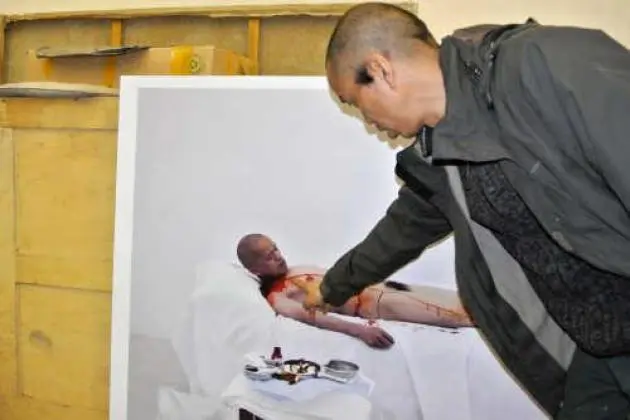
In a 2010 performance titled “One Metre Democracy”, He gathered 25 people for a poll on whether he should endure a knife gash – without anaesthetic – from his collarbone to his knee. They approved the idea 12-10 with three abstentions, and a doctor carried out the incision in a procedure that lasted several minutes, with voters posing for a group photo afterward while He lay naked and bloodied on a bed.
The artist has also stared at panels of 10,000 glaring watts of light bulbs to damage his eyesight, encased himself in a cube of quick-setting concrete for 24 hours, and burned his clothes while wearing them.
He once hung upside down from a crane for 90 minutes holding a knife in a rushing river, blood dripping from cuts in his arms made with the blade, in a symbolic mixing of the liquids.
Among his less extreme endeavours, he also carried a stone from a beach in England on a 112-day journey over 3,500 kilometres by foot – only to put the travel companion back where he found it.
“He Yunchang is an alchemist of pain,” says Judith Neilson, founder of the White Rabbit Gallery in Sydney, which specialises in contemporary Chinese art. “He Yunchang evidently believes that pain and extreme discomfort, deliberately planned and willingly undergone, have a transcendent quality – and that it is this quality that raises mere action to the level of art.”
His performances “serve as silent rebukes to contemporary Chinese society, where people undergo all kinds of suffering for money precisely because they see money as the ultimate protection against suffering”.
Although contemporary art has flourished in China in recent years, the ruling Communist Party maintains tight controls on freedom of expression and only a minority of artists conveys political messages with their work.
He has avoided directly confronting the authorities. “I generally stay quiet and calm. I don't make waves.” But China’s best-known dissident artist, Ai Weiwei, who has faced detention and strict surveillance for his more confrontational work, praises the approach of his friend and neighbour in Caochangdi, a community of avant-garde artists on the outskirts of the capital.
He’s art “always has a mix of play, personal history, political message and poetic romance”, says Ai. “Everything that’s happening in China today, with development, old structures and communist doctrines, are all stuck together.” He’s work “is trying to pull life out of the ruins”.
His performances aren’t always easy to carry out, and he has run into trouble with officialdom – although in the US, rather than in China. In 2005 police thwarted his attempt to stand naked on a rock atop Niagara Falls for 24 hours.
Two years later police in New York stopped him as he organised a game of mah-jong – again naked – using bricks in place of the usual domino-sized tiles.
Several hospitals refused to carry out the rib removal without medical justification until he found a willing doctor in his home province of Yunnan, in the southwest.
“This has been my wish for many years,” He told surgeons. “If you can help me realise it, then you’re actually helping me, not harming me.”
