
Making cities resilient


Play
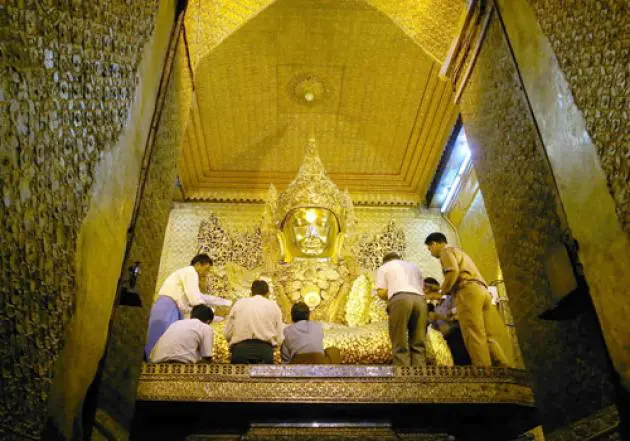
The Rockefeller Foundation commits to helping restore Mandalay's cultural heritage
The Rockefeller Foundation has announced it will fund cultural heritage restoration work in Mandalay, one of several cities around the world chosen to be part of the foundation’s “100 Resilient Cities”.
Myo Aung, a representative from Mandalay City Development Committee attended the City Creditworthiness Academy workshop held in Seoul, South Korea from April 21 to 26.
“The Rockefeller Foundation connects with the World Bank and helps in the development of many countries. Although Mandalay City has been approved to receive US$1 million (Bt32.5 million), more support can be obtained depending on the reports from officials and investigations, which are scheduled for this month,” Myo Aung says.
Mandalay City has already started work on a Green City plan with the help of the Asian Development Bank.
By including Mandalay on the list, the Rockefeller Foundation has indicated it is interested in supporting restoration projects in the city.
“Our discussions were listened to and answered directly by the Washington headquarters, and they asked us which organisations are helping us for the city development process,” Myo Aung explained.
He added that city development discussions have involved better cooperation with the central government.
The 100 Resilient Cities initiative is dedicated to helping cities adopt and incorporate a resilience mindset in their planning, development and community building, so that they are better prepared for and can quickly rebound from 21st-century shocks and stresses.
In applying for the “100 Resilient Cities Challenge,” cities were required to submit their visions, needs and plans to build resilience in a way that connects government, the private sector and civil society, and specifically addresses the needs of their poor and vulnerable citizens.
“The 33 cities we have named represent a diversity of urban resilience needs, and as the inaugural members of the 100 Resilient Cities Network they have much to share with and learn from each other. We are excited to get to work so that this dynamic group of cities are better prepared to withstand the shocks and stresses of our disruptive world,” said Judith Rodin, president of the Rockefeller Foundation.
Building resilience is about making people, communities and systems better prepared to withstand catastrophic events – both natural and man-made – and more able to bounce back quickly and stronger.
Cities were selected upon the recommendation of a distinguished panel of judges from around the world, including former presidents Bill Clinton of the US and Olusegun Obasanjo of Nigeria.
Among the 33 selected cities, there are several from the emerging world, among them Bangkok, Da Nang in Vietnam, Dakar in Senegal, Semarang in Indonesia and Surat in India.
Joining them are big cities in the developed world such as Rotterdam in the Netherlands, New York City, Bristol in the UK and Melbourne in Australia.
Through the network, member cities will win support and share new knowledge and resilience best practices.
They will also win support to hire or fund a chief resilience officer (CRO), who will help ensure resilience-building and coordination is the specific responsibility of one person in a city government.
Each CRO will also oversee the development of a resilience plan for a city, and be part of a learning network of other CROs as representatives to the 100 Resilient Cities Network.
They will win support to create a resilience plan that reflects each city’s distinct needs, as well as a platform to provide necessary tools and resources for implementation of the plan focused on four areas: innovative finance, innovative technology, infrastructure and land use, and community and social resilience.
The 100 Resilient Cities Centennial Challenge will open for its next round of city applications in the middle of this year.
Getting prepared
The 33 selected cities are:
Bangkok
Alameda, California
Berkeley, California
Boulder, Colorado
El Paso, Texas
Jacksonville, Florida
Los Angeles, California
New Orleans, Louisiana
New York City
Norfolk, Virginia
Oakland, California
San Francisco, California
Ashkelon, Israel
Bristol, UK
Byblos, Lebanon
Christchurch, New Zealand
Dakar, Senegal
Da Nang, Vietnam
Durban, South Africa
Glasgow, UK
Mandalay, Myanmar
Medellin, Colombia
Melbourne, Australia
Mexico City
Porto-Alegre, Brazil
Ramallah, Palestine
Rio de Janeiro, Brazil
Quito, Ecuador
Rome, Italy
Rotterdam, Netherlands
Semarang, Indonesia
Surat, India
Vejle, Denmark
Source: The Rockefeller Foundation
