
Surasi as reluctant champion


Play
World famous, he finally wins the Silpathorn Award in visual arts, but he's dismissive of the honour
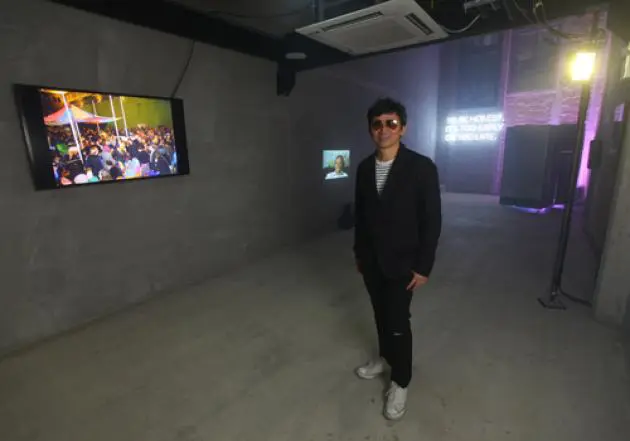
THE NEON SIGN greeting people arriving at the Silpathorn Awards ceremony last Thursday said, “To be honest, it’s too early or too late.” Surasi Kusolwong tends to get wordy with his installation “Time Travel (It is a very thin line, thinner than a piece of paper)”, but the various components were no less a highlight of the exhibition accompanying this year’s awards presentation at the Ratchadamnoen Contemporary Art Centre.
Long a bridesmaid, the internationally acclaimed conceptual artist Surasi finally became a bride this time around, snagging the “trophy” in the visual-arts category. He’s known for criticising institutions in his art, and, with “Time Travel”, he’s even taking on the way art centre is managed.
The neon work, Surasi says in notes attached to the big sign, repeats his response to a journalist friend who called him with congratulations on winning the award.
He seems ready to turn his back on the award, though, as suggested by a refrigerator he’s installed in the show backwards. He also seems to be saying that missing out on awards is no big deal, because he’s showing a BBC video of 1965 Nobel physics laureate Richard Feynman, the American pioneer in quantum mechanics and alumnus of the atomic-bomb project in World War II, saying “I don’t like honours.” There’s a picture of Surasi’s mother too, carrying a broken umbrella, illustrated with Buddhist text. Art that he’s shown around the world over the past two decades is displayed on a TV monitor.
It is Surasi who makes the exhibition worth seeing. The Culture Ministry’s Office of Contemporary Art and Culture has done a dull job presenting the work of other winners. It amounts to display boards with their biographies, panels of graphic designs, book covers, movie posters, videos of performances and architecture models.
The Silpathorn Awards honour mid-career artists age 30 to 50 for “outstanding merit, innovative contributions to their fields and a positive impact on society as a whole”. Each gets Bt100,000 and a lapel pin. Winners are selected for visual arts, literature, music, the performing arts, film, architecture, graphic design, creative design and decorative arts, although no one was named this year in the last category.
Established in 2004 by Professor Apinand Poshyananda, the awards have thus far been bestowed on 52 artists, annually but for the distracted years 2011 through 2013.
Two movies “Tang Wong” and “P-047” represent the 2014 champion in the cinema category, independent filmmaker Kongdej Jaturanrasmee. Rather than arranging screenings in a proper theatre, the organisers are projecting them against a concrete wall, with all the attendant echoes. Kongdej is nevertheless delighted to be honoured.
“I’m really proud of this award, which allows me to follow in the footsteps of Pen-ek Rattanarueng, Apichatpong Weerasethakul, Wisit Sasanatieng and Nonzee Nimitbutr, whom I respect so much,” the 42-year-old said, referring to the Silpathorn awardees from 2004, 2005, 2006 and 2008.
“I’ll spend the money on post-production for my new documentary-fiction ‘So Be It’, which has the backing of the Asian Cinema Fund from the Busan International Film Festival, and it will screen there in October and then be released in Thailand.”
“So Be It” was also among 25 projects chosen for the Hong Kong-Asia Film Financing Forum this year. It’s about two boys from different backgrounds who seek out life’s answers as Buddhist monks.
Kongdej, who tackles whatever tasks are necessary – promoter, screenwriter, director – earned an honourable mention at the Seattle festival in 2003 with his debut “Sayew” and the best-screenplay award at the Deauville Asian Film Festival in 2006 with his romantic comedy “Midnight My Love”. In 2011, “P-047” was named best picture at the Five Flavours festival in Poland and selected for Venice. And last year “Tang Wong” garnered Subhanahongsa Awards for best film and screenplay while also screening in Berlin.
In music, Vanich Potavanich is conducting a small orchestra – on a TV screen at least. Headphones are available. You also get to appreciate his talent with a trumpet and as a composer. He has performed with the Bangkok Symphony Orchestra for 18 years and has conducted that assembly, the National Symphony Orchestra and the Rangsit Philharmonic. He’s composed more than 400 pieces, including “King of Peace”, “Bangkok Fantasia” and “Malai”.
The literature award went to self-taught writer Rewat Panpipat, a small library of whose books are available for browsing. Among them is “Maenam Ramluk” (“River in Remember”), the poem that won the 2004 SEA Write Award and made the Suphan Buri native regionally famous. He writes primarily about his personal life in a rural setting, celebrating harmony with nature, as in “Mae Nam Diew Kan” (“The Same River”) and “Nak Pan Nam” (“The Water Shaper”).
Another TV set “broadcasts” Jarunan Phantachat in action, winner in the performing-arts section. Now living in New York, she was one of the pioneers of “physical dance”, with remarkable shows that include “Shatter Room No 0”, an example of “object theatre”, and the interactive “Taste of Curry”. Jarunan is clearly richly deserving of Silpathorn honours, though there has been criticism that this year’s award should have instead gone to the more acclaimed Teerawat Mulvilai, who co-founded the B-Floor Troupe with Jarunan in 1999.
In the creative-design category, Chaiyuth Plypetch’s clever ideas for retail products were an obvious choice. He’s the whiz behind the brand Propaganda, and functional designs with a sense of humour form his signature. “Shark”, a bottle opener shaped like a shark’s fin, won a prize at Chicago’s Athenaeum Museum of Architecture and Design. “Mr P”, a lamp in the shape of a boy peeing, has been evoking chuckles around the world.
Architect Suriya Umpansiritatana picked up his award for structures like the eco-friendly monks’ quarters at Wat Khao Buddhakodom in Chon Buri. In 2012 Suriya became the first Thai to win the Global Award for Sustainable Architecture, from the Unesco-sponsored Locus Foundation.
And, in graphic design, that retro “Siamese” font you’ve seen in the titles of movies including “Fah Talai Jone”, “Mekhong Full Moon Party”, “Citizen Dog” and “The Unseeable” earned the honours for typographer Pairoj Teeraprapar. The Silpakorn University graduate found a way of making Thai characters evoke the “good old days”, and now graces Chonabot-brand T-shirts and keepsakes available at Chatuchak Weekend Market and Siam Square.
HOW IT’S WON
The exhibition of work by the Silpathorn laureates continues until Sunday at the Rachadamnoen Contemporary Art Centre.
Watch Kongdej’s “P–047” at 10.30am and 6pm today through Friday and at 10.30am at the weekend. His “Tang Wong” screens at 6pm on the weekend.
