
Art in an urban landscape


Play
Seoul's "creative spaces" support activities for the benefit of both artists and art lovers
A decade ago the underground section of the Jungang Traditional Market in Seoul’s Sindang-dong district was a place without a future. As merchants left the area one by one, what was once the site of flourishing small businesses had turned into a dungeon that few cared to visit.
The fortune of this unfrequented area of Seoul was reversed in October 2007 when the Sindang Creative Arcade opened. The arcade is one of nine “creative spaces” currently under the auspices of the Seoul Foundation for Arts and Culture, an organisation founded by the Seoul Metropolitan Government to support creative and artistic activities for the benefit of Seoul citizens.
“Creative spaces” represent Seoul’s latest efforts to enhance the quality of urban living by integrating arts into the fabric of everyday life. Each “creative space” was previously unused real estate, subsequently transformed into a meeting place for artists and Seoul citizens.
The abandoned cubicles in the underground section were reborn as workspaces for artists and designers in what is now the Sindang Creative Arcade, and similar stories of urban regeneration can be recounted for each “creative space,” previously an unused factory, government building or public centre.
While sharing this common vision, each “creative space” thrives in its distinctiveness. Sindang Creative Arcade, for example, is home to artists specialising in craftwork, such as “book artist,” Ahn Kyung-hee, who occupies one of 41 workstations in the arcade.
“Artists are foremost in need of a space where they can engage in artistic endeavours,” Ahn explains
Admission into a “creative space” as a resident artist is by application, and successful applicants have access to the facilities, which include writer’s rooms at Yeonhui Writers’ Village, dance studios at Hongeun Art Creativity Centre and workspaces at Mullae Art Factory. There’s a minimal fee and certain obligations, such as helping set up programmes for the public.
While the notion of transforming unused spaces to be used by artists is easy to follow, how to connect the dots between “creative spaces” and the public so that art can play a larger role in the lives of the average citizen who may not have an interest in becoming a professional artist is less clear.
The Seongbuk Art Creativity Centre, another “creative space” funded by the Seoul foundation at the Seongbuk District’s former public health centre, for example, has made art therapy central to its identity. The only one of its kind in Korea, the centre has invited professional art and music therapists to conduct programmes for children, housewives, pregnant women and fire-fighters.
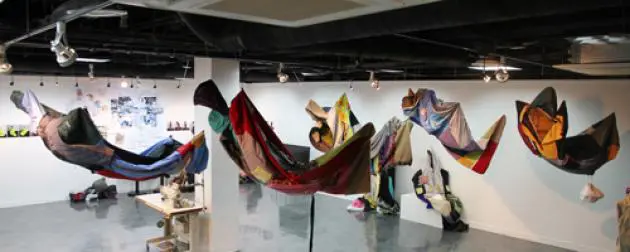
In addition, the centre’s resident artists have incorporated the theme of “healing” into their projects. Last year, Ann Hyun-suk, a specialist in community art, spearheaded a campaign “the Folding Zip House project” to transform clothes donated by citizens into sleeping bags for the homeless with the centre’s backing.
Stressing that “art is something that we share and not own,” Ann described the ameliorative effects of her project, which invited residents of homeless shelters to participate in the making of sleeping bags for those on the street.
Her work, Ann explained, promotes healing at multiple levels, from the healing of spaces associated with social malaise, to the healing of citizens who by donating clothes to her project feel connected to society at large, as well as the healing of the homeless who “come to realise that they are not neglected.”
Ann’s project and many others like hers push the boundaries of what constitutes as “creative spaces.” Though
headquartered in an office provided by the Seongbuk Art Creativity Centre her project shows that “creative spaces” are not confined to the building itself, but may extend beyond its premises as art links formerly unconnected spaces through human relationships.
The Sindang Creative Arcade, in contrast, has approached the problem of making creative spaces the focal point of civic life differently. There the puzzle has been to make the “creative space” relevant to the immediate vicinity – Jungang Traditional Market.
According to the supervising manager of the arcade, Kim Jin-ho, the relationship between the arcade and the merchants in Jungang market was initially frosty, as the latter feared that events put on by the arcade would disrupt their business.
Trust gradually developed as Kim and his team took steps to bring together artists and merchants so that they could identify ways in which each side could further the other’s goals.
“Originally, our goal was to popularise the arcade as much as possible,” explained Kim. “We later recognised that attracting too much attention could harm Joongang’s merchants because it would lead to the commercialisation of the area, which would drive out small businesses. We have had
to adjust our goals accordingly.”
The struggle to make “creative spaces” viable continues, even as previously unused spaces, like the underground section of the Jungang market or the former public health centre in Seongbuk District, are given a new lease on life. Satisfying the needs of the public and meeting the demands of artists form two parts of an equation which holds the key to Seoul’s “creative spaces.”
“When you take into account the limited resources that we have to had work with,” says Sun Girl, a member of the management team at Seongbuk Art Creativity Centre, “the fact that we have been able to host increasing numbers of projects each year since the centre’s inception to great success shows how a little for the arts can go a long way.”
